


As transport and industrial sectors accelerate to achieve electrification and eliminate dependence on fossil fuels, the demand for sustainable battery production is mounting. The European Parliament is pushing to ban the sale of new internal combustion engine cars by 2035, meaning the demand for battery materials will continue to increase dramatically.1 By 2030 the EU will need 5 times more cobalt and 18 times more lithium compared to the demand in 2018, numbers which exponentially increase when estimating demand in 2050.2 If electrification is to be a truly sustainable transition, a system-level approach must be taken to ensure sustainable material sourcing, efficient battery production, and effective end-of-life processing.

The update to the 2006 Battery Directive3 aims to ensure that the growth of the battery industry is done sustainably. In July 2023, the EU Battery Regulation Amendment was adopted by the EU Council, laying out the structure to achieve sustainable battery lifecycles. This includes a digital record system to enable the transfer of key information between parties – the battery passport, which is detailed in Chapter IX of the regulation.4
Who does the battery passport regulation affect?
According to the Battery Regulation update, every industrial or electric vehicle (EV) battery on the EU market with a capacity of over 2 kWh will require a battery passport. This means that regardless of the origin of the battery, it will require a battery passport to be listed in the European market. It will be the responsibility of the party placing the battery on the market to ensure that all data required is entered into the digital record and that the information is correct and up to date. Additionally, the new regulation also includes light means of transport (LMT) batteries, which must comply with the outlined requirements.
Battery passports will therefore require input from:
- Mining and refining companies
- Cell and battery producers
- Vehicle brands
- Battery servicing, refurbishing, and recycling companies
What information will need to be included in the battery passport?
The battery passport must contain information on the following:
- Identification of the battery in the form of a unique identifier.
- Basic characteristics of the battery including type and model.
- For the initial 2027 battery passport, only basic battery identification, type, model, and key technical characteristics are required. Updates on lifecycle performance and durability statistics may be mandated in future delegated acts, but are not legally required at the first implementation stage.
- Carbon footprint specific to the manufacturing site and batch of batteries.
Technical documentation on the electrochemical performance and durability of the battery must be provided, including details on how this data was obtained. This is to ensure the batteries meet the minimum requirements for battery performance and capacity in order to guarantee batteries on the market are operational and efficient over a sufficient lifetime.
To gain access to the battery passport, the physical battery must have a QR code printed or engraved on it to act as a unique product identifier.5


Information stored in the battery passport will need to be selectively shared with three distinct groups: the general public, regulatory bodies, and battery service and end-of-life processors. Each group of users will need to have different read and write permissions for the data in each battery passport so that everyone has the information they need while data privacy is maintained. The precise data points each group of users requires access to are detailed in Annex XIII.
The Battery Regulation embeds a broad framework for making key data available across the battery value chain. From chemical composition and recycled content to carbon-footprint declarations and the upcoming battery passport, the regulation sets structured requirements for transparency and traceability. While the battery passport is formally mandated for relevant batteries from 18 February 2027 and acts as the core data-record platform, the Regulation also anticipates that further delegated acts will expand both the scope and format of required data disclosure. At the same time, the Regulation emphasises the protection of commercially sensitive information: economic operators must ensure that confidential business data, including intellectual-property-protected material and competitive information, is safeguarded when fulfilling information-sharing obligations.
https://youtu.be/CIsQnu7kP5s?feature=shared
When will battery passports be required?
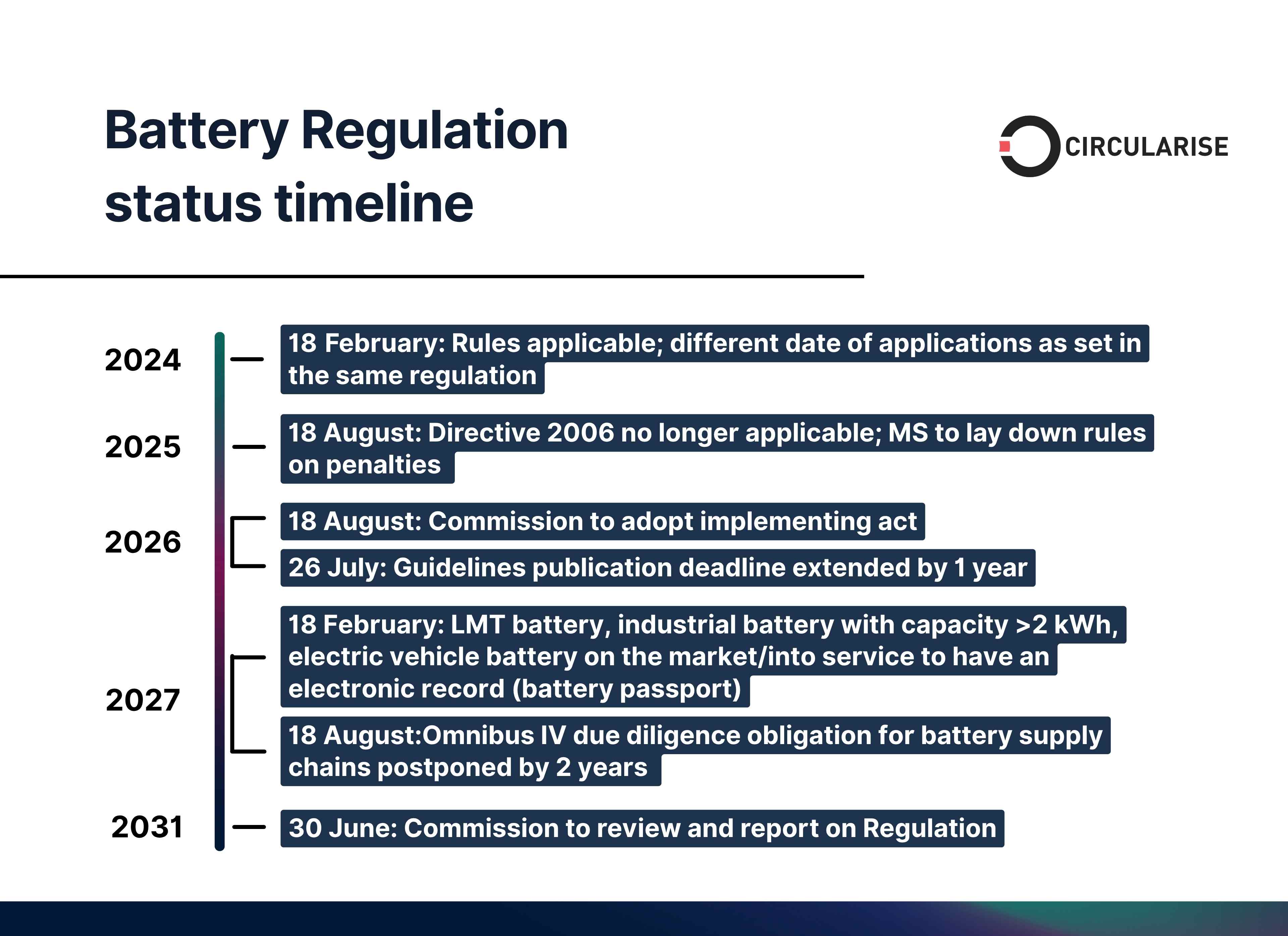
As the European Union accelerates its shift toward sustainable electrification, the EU Battery Regulation (Regulation (EU) 2023/1542) sets the foundation for responsible battery production, use, and end-of-life management across the bloc. Replacing the 2006 Battery Directive, the regulation introduces a comprehensive lifecycle approach — from raw material sourcing and manufacturing to reuse and recycling. Following its entry into force on 17 August 2023, a series of key implementation deadlines will progressively apply, including battery passport requirements, due diligence obligations, and recycled content targets — each designed to ensure transparency, traceability, and sustainability across the European battery value chain.
- Battery Passport implementation:
- From 18 February 2027, all electric vehicle (EV) and industrial batteries with a capacity greater than 2 kWh placed on the EU market must have a digital battery passport, accessible via a QR code.
- Due dilligence obligations:
- Originally set for 18 August 2025, the application date for due diligence obligations was postponed to 18 August 2027 through Regulation (EU) 2025/1561, allowing economic operators additional time to prepare.
- Recycled content requirements:
- From 18 August 2031, batteries placed on the EU market must meet minimum recycled content thresholds for cobalt, lead, lithium, and nickel.
Interoperable, transferable, and trustworthy battery passports
There are stringent requirements for the systems used to create battery passports, therefore you must ensure that the system you choose meets the EU requirements for a scalable and reliable battery passport network.
All information included in the battery passport needs to be based on open standards and be in an interoperable format that is transferable through an open interoperable data exchange network such as Catena-X. There are clear requirements for selective data access, editing, and sharing, while also maintaining a high level of data security and privacy. Therefore you must choose a system with strong selective data sharing capabilities that ensure data privacy.
Data authentication, reliability, and integrity must also be ensured. Therefore using a private cloud or blockchain-based system could risk non-conformity due to their weaknesses in this area. It is worth considering more decentralised systems which excel in data immutability.
What is decentralised data storage?
Decentralised data storage involves keeping data in multiple interconnected locations rather than in a single centralised point. This approach ensures the integrity of a single source of truth, such as a manufacturer's bill of materials, while allowing for the necessary information to be continually distributed as required to selected parties in a peer-to-peer fashion. A strategy that is also supported by the EU Data Economy Strategy.6
Mr Thomas Götz from the Wuppertal Institute explained the current landscape of digital product passports and how it brings together data in one place, while also emphasising the need to do this in a decentralised way:
“A decentralised approach using data from different sources is - especially from the beginning phase onwards - very important because the spread data has to be brought together. It’s reasonable to use existing data and link to it from the DPP so that (...) all needed information is collected and can be found in one place.”
Learn more about the importance of decentralisation and data security for digital product passports
2025 product carbon footprint for electric vehicle batteries
From 18 February 2025, manufacturers must calculate and declare the carbon footprint for each battery model and manufacturing plant, including emissions from all relevant lifecycle stages. The declaration must include emissions from all relevant lifecycle stages — extraction and processing of raw materials, active material and cell manufacturing, battery assembly, distribution, and end-of-life processing. This carbon footprint data must be third-party verified and made publicly accessible online via a weblink.
While these data are not yet required to be stored within the battery passport until 18 February 2027, the 2025 declaration serves as a preparatory phase for the full traceability requirements that follow.
JRC's methodology for calculating and verifying carbon footprints requires site-specific and batch-level data for each manufacturing facility.12 Carbon offsets cannot be used to reduce reported emissions. Over time, this information will form the basis for carbon footprint performance classes, allowing batteries to be categorised by environmental impact.