

.jpg)
Introduction
On 29 June 2026, the Council of the EU formally adopted the End-of-Life Vehicles Regulation, the instrument that replaces the two-decade-old End-of-Life Vehicles Directive. It is easy to read it as another recycling rule. That would be a mistake.
Around 6.5 million vehicles reach the end of their life in the EU every year (European Parliament, 2023), and the critical raw materials inside components such as electric-drive motors are still largely lost after shredding. As Europe electrifies and worries about access to those same materials, what happens to a vehicle after it leaves the road has become an industrial question, not just an environmental one. Every electric vehicle sold today is also a future source of steel, aluminium, plastics, batteries, and rare earths.
The Regulation responds to that shift. It links vehicle design, manufacturing, repair, dismantling, reuse, recycling, and digital information into one framework, and it introduces a new record, the Digital Circularity Vehicle Passport, to carry the data through the whole lifecycle. For manufacturers, and for any company supplying the EU market from outside it, traceability and material transparency are moving from compliance box-ticking to a core business capability.
This blog covers four things:
- What the Regulation changes, and who it applies to.
- The specific obligations, from the circularity strategy to recycled-content rules and the vehicle passport.
- The timeline, and why the data work has to start well before the headline 2032 deadline.
- A readiness checklist you can run against your own organisation.
From waste legislation to industrial strategy
Vehicles are no longer just products that move people until a newer model replaces them. In an electrified market, they are long-term stores of strategically important materials, and recovering those materials has become an industrial priority. The challenge is no longer recycling a vehicle at the end. It is keeping its materials visible, recoverable, and available for the next generation of products.

The Regulation reaches most of the automotive value chain. Full requirements apply to passenger cars and light commercial vans, with a lighter set of obligations for heavy-duty vehicles, motorcycles, and special-purpose vehicles (CDX, 2026). The primary duty sits with vehicle manufacturers, but it flows through to tier suppliers, dismantlers, and recyclers, because the data and the physical components have to move between all of them.
It also does not stand alone. The Regulation works alongside Euro 7 on environmental performance, the EU Battery Regulation and its Battery Passport, the Critical Raw Materials Act on strategic materials and permanent magnets, and the Ecodesign for Sustainable Products Regulation (ESPR), which sets the horizontal Digital Product Passport framework that vehicles and their components will plug into. Different regulations, one shared objective: making product data interoperable across the vehicle lifecycle. We covered how these fit together in Part 2 of this series.
What the Regulation requires
The headline change is a shift from recycling targets to designed-in circularity, backed by data. A few obligations matter most.
A manufacturer circularity strategy. Within 36 months of the Regulation entering into force, every manufacturer must publish a circularity strategy setting out how it will meet the requirements, and update it every five years. This is the document that forces circularity into product planning rather than leaving it to end-of-life operators.
Stronger critical-raw-material recovery. This is where the Regulation aligns directly with the Critical Raw Materials Act. It requires manufacturers to design e-drive motors and other critical-raw-material-containing components for removal before shredding, and it empowers the Commission to set minimum recycled-content requirements for the rare earths used in permanent magnets: neodymium, dysprosium, praseodymium, terbium, and samarium, alongside boron (IEA, 2026). Recovering these materials, rather than losing them in the shredder, is the point.
Recycled content becomes the standard. At least 15% of the plastic in a new vehicle must come from recycling within six years of entry into force, rising to 25% within ten years, with a share of that drawn from end-of-life vehicles (Resourcify, 2026). The Regulation also brings in mandatory recycled-content declarations for steel, aluminium, magnesium, permanent magnets, and other relevant materials.
Better information for dismantlers. Manufacturers must supply technical documentation identifying critical-raw-material-containing components and supporting high-quality recovery, so that the people taking a vehicle apart know what is inside it and where.
The common thread is not recycling. It is knowing what is inside a product, where the materials are, and how they can be recovered when they are needed. Digital traceability is what makes that possible, and it is the reason the Regulation puts a data record at its centre.
The Digital Circularity Vehicle Passport
The Regulation's defining feature is the Digital Circularity Vehicle Passport (DCVP). Within 72 months of entry into force, expected around 2032, every new vehicle placed on the EU market will have to carry one (iPoint, 2026).
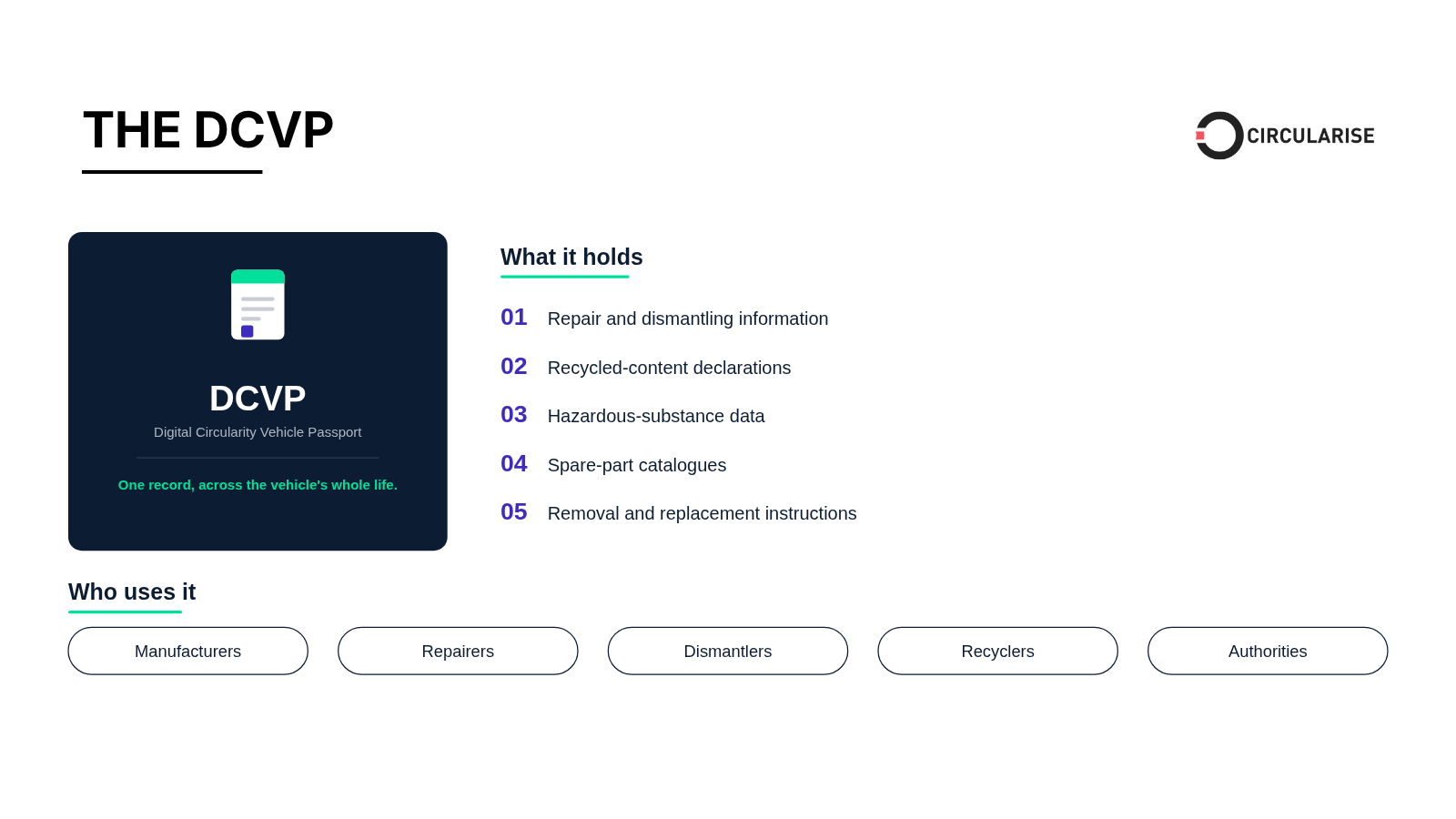
The DCVP is not a compliance PDF, and it is not just a QR code. It is the central access point for information across a vehicle's life, giving manufacturers, repairers, dismantlers, recyclers, and authorities the data they need to keep parts and materials in use for longer. It carries, or links to, repair and dismantling information, recycled-content declarations, data on hazardous substances under applicable exemptions, spare-part catalogues, and instructions for removing and replacing components.
It also fits a bigger pattern. The EU is building a horizontal Digital Product Passport framework through the ESPR, then adding product-specific requirements through delegated acts for batteries, vehicles, and other product groups. For any company facing more than one passport obligation, the direction is clear: build around a common digital structure once, then add the product-specific data points as each set of rules arrives. In practice, the DCVP turns vehicle circularity from a static reporting exercise into a living information system.
What it means for EV batteries
For anyone coming at this from the battery angle, this is where the Regulation touches the battery directly. An EV battery is the highest-value material store in the vehicle, and the Regulation treats it accordingly. Batteries, battery packs, and e-drive motors must be removable before a vehicle is shredded, so they can be routed to reuse, second-life, or recycling rather than lost (IEA, 2026).
That creates a handoff most companies underestimate. The vehicle side of the battery's story lives in the DCVP; the battery side lives in the EU Battery Passport, mandatory from 18 February 2027. They describe the same physical asset from two ends, and the data has to line up. A manufacturer, recycler, or second-life operator that builds these as two separate systems will duplicate effort and end up with records that do not reconcile. The same is true of the magnet materials the Regulation shares with the Critical Raw Materials Act, which we cover in Part 3 of this series.
Timeline: what's ahead
The Regulation applies progressively. The milestones are not isolated deadlines; each one builds toward circularity that is measurable, verifiable, and operational.
| Date | Milestone |
|---|---|
| 29 June 2026 | Regulation formally adopted by the Council; enters into force shortly after publication in the Official Journal |
| 2027 | Commission feasibility assessments for recycled steel and aluminium |
| 2028 | Methodologies for calculating and verifying recycled content; implementing work on the DCVP |
| 2029 | Manufacturer circularity strategies become mandatory; extended producer responsibility obligations apply; technical information on batteries, e-drive motors, and critical-raw-material components becomes available |
| 2030 | Implementing acts for the DCVP expected |
| 2032 | DCVP mandatory; design-for-removal obligations apply to EV batteries, packs, and e-drive motors; recycled-plastic and recyclability requirements begin |
| 2033 | Minimum recycled-content obligations for steel and aluminium begin, subject to delegated acts |
Read from the 2032 deadline, the runway is shorter than it looks. Collecting and verifying multi-tier supplier data, agreeing data-exchange standards, and standing up the systems to run a DCVP takes time, and none of it comes together in the final year. The circularity strategy, supplier information, and component-level data all have to be underway well before then. For most manufacturers, that means starting in 2026 and 2027, not 2031.
A readiness checklist
Run this against your own organisation. If any answer is "not yet" or "we don't know", treat it as a gap to close now, not in 2031.
☐ Circularity strategy owner. Someone accountable for the manufacturer circularity strategy and its five-yearly updates, with the design, procurement, and end-of-life inputs it needs.
☐ Component-level material data. Composition and recycled-content data for the materials the Regulation names, including plastics, steel, aluminium, magnesium, and permanent magnets.
☐ Design-for-removal. Batteries, packs, and e-drive motors designed to be removed before shredding, with removal and replacement instructions documented.
☐ Multi-tier supplier data collection. A way to gather verified data from the suppliers who actually handle the materials, rather than relying on self-attestation.
☐ Recycled-content tracking. The ability to calculate and evidence recycled shares against the plastic and metal thresholds as they phase in.
☐ DCVP data structure. A digital record that can hold or link to repair, dismantling, recycled-content, hazardous-substance, and spare-part information, and update through the vehicle's life.
☐ Battery Passport alignment. A single data layer that serves both the DCVP and the EU Battery Passport, so the two records reconcile rather than compete.
If you would like to walk through where you sit on each item, get in touch.
The automotive regulatory landscape
No manufacturer is preparing for the End-of-Life Vehicles Regulation in isolation. It sits inside a set of regulations that point the same way.
| Regulation | Contribution |
|---|---|
| Critical Raw Materials Act | Traceability and recycled-content disclosures for permanent magnets and strategic raw materials |
| EU Battery Regulation | The Battery Passport, sustainability and due diligence obligations, and battery lifecycle data |
| ESPR | The horizontal Digital Product Passport framework and future product-specific ecodesign rules |
| Euro 7 | Environmental-performance information and digital vehicle-related data |
Treated as separate compliance projects, they multiply cost and produce data sets that cannot talk to each other. Treated as one supplier-data problem, they share a backbone.
Where Circularise fits
The Regulation is a supplier-data problem first and a labelling problem second. Circularise runs one platform across the whole flow, structured as three steps.
- Collect. Our supplier data collection runs structured, multi-tier campaigns to gather material, composition, and recycled-content data from deep in the supply chain.
- Trace. Chain-of-custody tracing records critical raw materials batch by batch, producing the auditable evidence the Regulation relies on.
- Share. We publish digital product passports, including DCVPs, EU Battery Passports, and permanent-magnet records, off the same data layer, so one set of verified data serves every obligation.
This is not theoretical for us. Through EU-funded projects such as REEsilience, which works to build more resilient and sustainable rare-earth magnet supply chains in Europe, and CSyARES, a recently completed project on rare-earth traceability, we have seen first-hand how traceability connects primary and secondary material flows, improves data exchange between supply-chain actors, and supports the use of recycled critical raw materials in demanding applications.

Closing
The End-of-Life Vehicles Regulation marks the point where vehicle circularity stops being an environmental obligation and becomes an industrial strategy. As raw materials grow more strategic, manufacturers will need real visibility over where materials come from, how they move, and how they can be recovered at the end of a vehicle's life. Circularity alone cannot deliver that. It depends on reliable, interoperable, and trusted product data.
The automotive industry spent decades optimising how vehicles move across global supply chains. The next challenge is doing the same for the information that travels with them. The DCVP is mandatory from 2032, but the data work behind it starts now. Companies that begin building this capability today will be far better positioned for the regulations, and the markets, of tomorrow.
If you want to map your End-of-Life Vehicles Regulation exposure and what it would take to close the data gap, talk to us.