
Tracing recycled polycarbonate resins from source to finished product
In a focused effort to prove the circular value of its recycled materials, Teijin Limited partnered with Circularise Japan to pilot Digital Product Passports (DPPs) for Panlite® CM and Multilon® CM, recycled polycarbonate resins derived from end-of-life vehicles. The project traced material origin, recycled content, and supply chain data from source to finished product, while keeping confidential business information protected throughout. The results confirmed DPPs as a practical tool for verifying circular materials and building a foundation for compliance with emerging European regulations, including the proposed ELV Regulation.
“Circularise had already demonstrated traceability for our aramid and carbon fibre products through DPP. By partnering with Circularise again, we set out to make the invisible history of our newly developed solvent-based recycled polycarbonate resin visible and verifiable, and to bring the value embedded in the material to life for our customers.”
Key results
END-TO-END TRACEABILITY
Verified origin and recycled content of polycarbonate resins derived from end-of-life vehicles
SECURE DATA SHARING
Protected confidential supplier information while enabling transparency across the supply chain
REGULATION-READY FOUNDATION
Established a data infrastructure aligned with ESPR, EU Battery Regulation, and ELV Regulation requirements
About Teijin Limited
Teijin (TSE: 3401) is a global group that co-creates value with Customer-Driven businesses across the Apparel & Industries, Healthcare & Life Solutions, Electronics & Energy, and Specialty Materials domains. Established in 1918 as Japan’s first rayon manufacturer, Teijin today comprises some 125 companies employing approximately 15,700 people.
Teijin is committed to its Purpose: Pioneering solutions together for a healthy planet. Teijin works together with employees and external partners to achieve its Long-Term Vision: To be a company that supports the society of the future. Teijin posted consolidated revenue of JPY 873.2 billion and total assets of JPY 920.1 billion in the fiscal year ending March 31, 2026.
About Circularise
Circularise is a supply chain traceability platform based in the Netherlands, helping companies build more resilient operations, reduce emissions, and unlock new business value. Since 2016, it has enabled secure, end-to-end product traceability and deep supplier data collection beyond tier 1. Circularise supports the implementation of Digital Product Passports and simplifies compliance with regulations including the ESPR, RED III, and the EU Battery Regulation.
Trusted by industry leaders including Asahi Kasei, Samsonite, and Airbus, Circularise’s patented technology safeguards sensitive data while delivering audit-ready insights that power sustainable and profitable growth. In 2025, Circularise established Circularise Japan to strengthen its support for Japanese companies.
Why Teijin chose Digital Product Passports for recycled resin traceability
Supply chain transparency has evolved from a compliance requirement into a strategic business priority. As shifting tariff policies, geopolitical risks, and tightening regulations continue to reshape global markets, companies face growing pressure to verify and demonstrate the origin of their materials across every tier of the supply chain.
Teijin has been at the forefront of this shift. Through earlier Digital Product Passport initiatives for its aramid and carbon fibre products, the company built practical experience with supply chain traceability, exploring both its potential and its challenges. Those projects laid the groundwork for a broader vision: extending DPP capabilities to new materials and new regulatory contexts.
Building on those learnings, Teijin partnered with Circularise Japan to assess the effectiveness of DPPs for polycarbonate resins used in automotive applications, with a particular focus on future compliance with the proposed End-of-Life Vehicles (ELV) Regulation.
The decision to partner with Circularise again was grounded in the trust established through previous successful projects, combined with Circularise’s deep understanding of regulatory requirements and market developments. With the ELV Regulation, ESPR, and EU Battery Regulation all moving towards mandatory traceability, Teijin recognised that Circularise offers more than data visibility: it provides a practical, scalable traceability foundation designed for real-world regulatory compliance.
Key evaluation criteria included:
- Traceability across the supply chain
- Visualise raw material origins through Digital Product Passports
- A data management foundation aligned with regulatory requirements
- Secure information sharing that protects confidential business data
- Flexibility to integrate with existing IT infrastructure
Circularise’s patented technology enables suppliers to share verified sustainability and traceability data without exposing sensitive business information. Its ability to work within existing infrastructure, without requiring large-scale system replacements, was also an important factor in moving the project forward.
Tracing recycled polycarbonate resins across the supply chain
Teijin and Circularise collaborated on a supply chain transparency pilot for two of Teijin’s ELV-compliant recycled polycarbonate resin grades: Panlite® CM and Multilon® CM. Both materials are produced using feedstock recovered from end-of-life vehicles and are attracting growing attention as circular solutions aligned with future ELV regulatory requirements.
The project connected the following information to a Digital Product Passport:
- Raw material information confirming end-of-life vehicle origin
- Recycled content percentage
- Recycling methods applied to recycled materials
- Material property data
- Compliance-related information
- Supply chain traceability records
Using Circularise’s technology, suppliers shared relevant data securely while maintaining full confidentiality around manufacturing conditions, commercial relationships, and other sensitive information. This enabled reliable verification of material origins across a complex, multi-tier supply chain.
How Digital Product Passports verified recycled material value
The project successfully demonstrated that Digital Product Passports can verify the origin, recycled content, and supply chain integrity of recycled polycarbonate resins derived from end-of-life vehicles, providing both the data transparency customers require and the compliance foundation regulators will expect.
Key outcomes included:
- Verification of the authenticity of ELV-derived materials
- Visibility into recycled content percentages
- Increased transparency across the supply chain
- Secure data sharing while protecting confidential information
- Creation of a traceability data foundation suitable for regulatory compliance
The initiative is also expected to support future compliance efforts related to key European regulations, including:
- Ecodesign for Sustainable Products Regulation (ESPR)
- EU Battery Regulation
- End-of-Life Vehicles (ELV) Regulation
Industry recognition
The project was showcased at the Sustainable Material Expo (SUSMA) in November 2025 at Makuhari Messe, Japan, and at CHINAPLAS 2026 in Shanghai. Both demonstrations attracted significant interest from leading automotive manufacturers and component suppliers worldwide.
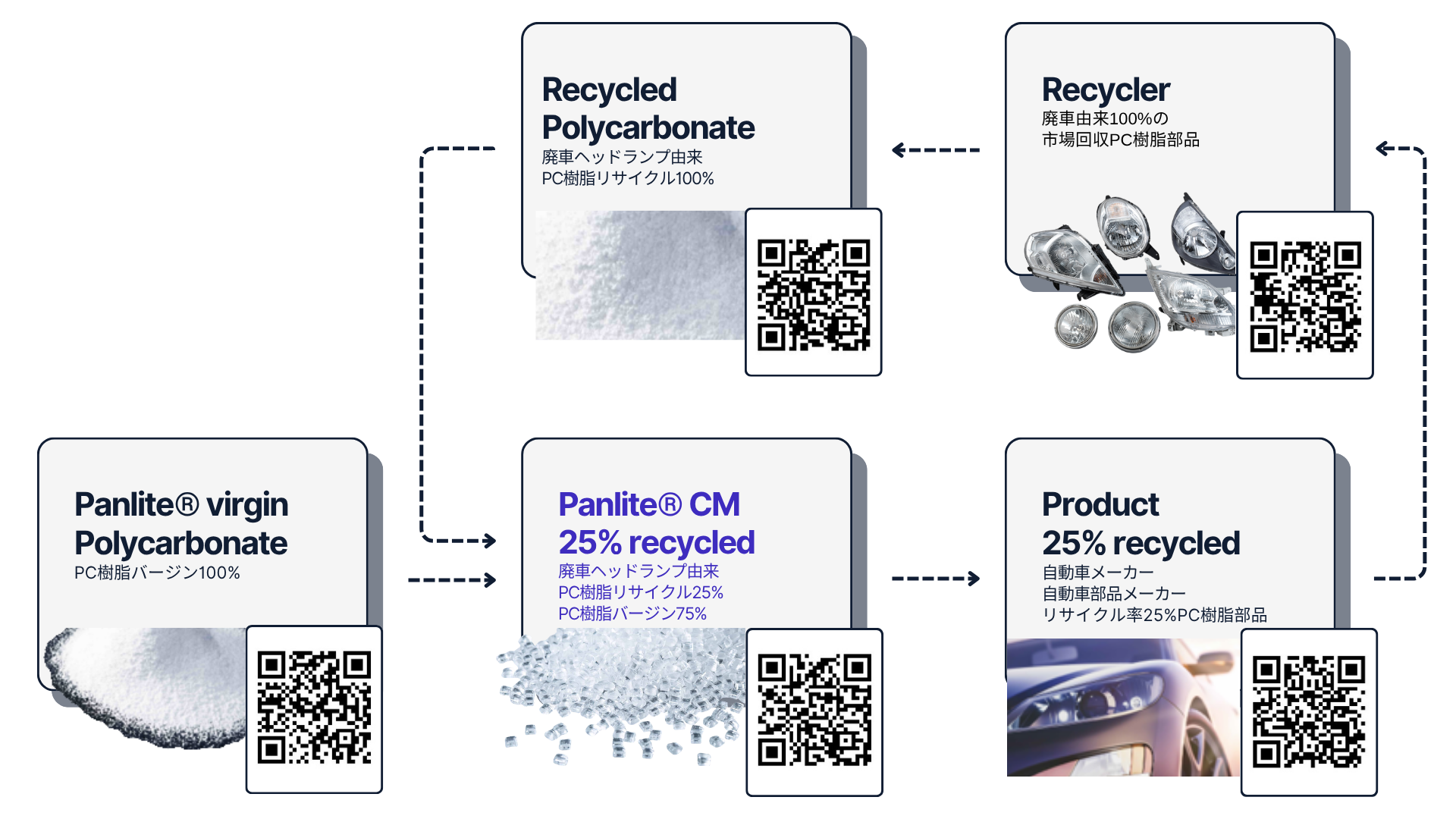
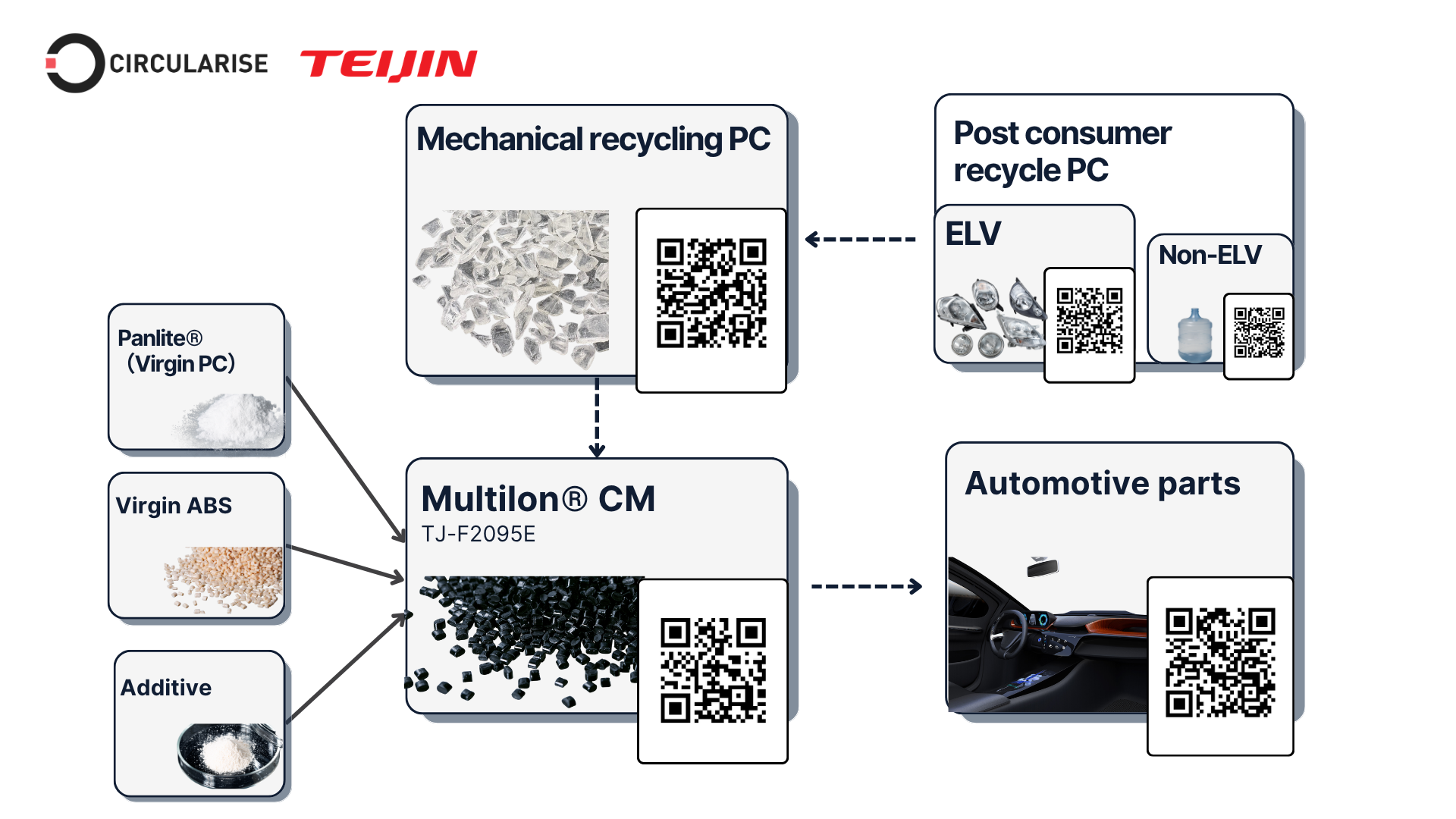
“By showcasing the Digital Product Passports for Panlite® CM (a solvent-based recycled polycarbonate resin) and Multilon® CM (ELV-compliant material-recycled PC/ABS resin) at SUSMA 2025 and CHINAPLAS 2026, we were able to demonstrate how invisible trust can become visible value. The response from customers in Japan and internationally was strong, and the initiative has accelerated our customer-centric approach to business innovation.”
Expanding Digital Product Passports across products and markets
Building on this project, Teijin and Circularise aim to extend the use of Digital Product Passports across a broader range of products and business areas. Future efforts will focus on:
- Deepening end-to-end supply chain visibility
- Streamlining regulatory compliance processes
- Advancing circular economy initiatives
- Strengthening supply chain resilience
By continuing to invest in traceability, both organisations are working to turn transparency into a source of competitive advantage. This project demonstrates that Digital Product Passports are more than a compliance or information management tool: they can serve as a strategic foundation supporting sustainability goals, regulatory readiness, business continuity, and long-term value creation.
Ready to transform your supply chain and embrace circularity?
See how Digital Product Passports can help you comply, compete, and scale circularity. Talk to our team today.