


Introduction
In April 2025, China introduced export controls on seven rare earth elements, extended to twelve in October. The controls didn't cap volume. They required batch-level documentation for every export permit, and the resulting permit backlogs rippled across Europe's rare-earth supply chain (CLEPA, June 2025). Over 80% of large European firms sit within three supply chain steps of a rare earth producer (ECB, November 2025). EU demand for rare earths is projected to grow 10x to 60x by 2050, depending on the technology mix (EPRS, 2023). The exposure isn't theoretical, and it isn't going down.
The same geopolitical risk that makes CRM traceability urgent also makes digital traceability systems harder to implement. Many battery and magnet supply chains rely on data generated outside the EU, including in jurisdictions where data transfers may be restricted. Building the supplier data backbone needed to satisfy EU regulators is, increasingly, a cross-border data governance problem as much as a sustainability one.
Two pieces of EU regulation are now bearing down on those same supply chains, and they're asking the same thing: where did this material come from, what's in it, who handled it, and how much of it is recycled?
The first is the Critical Raw Materials Act (Regulation (EU) 2024/1252). It sets EU-wide targets for 34 critical and 17 strategic raw materials, and introduces product-level rules on permanent magnets. The second is the EU Battery Regulation (Regulation (EU) 2023/1542). It locks in recycled-content thresholds, due diligence obligations, and the mandatory Battery Passport for every electric vehicle (EV), light means of transport (LMT), and industrial battery above 2 kWh placed on the EU market from 18 February 2027.
Here's the part most readers miss. The CRM Act is really two regulations sitting under one umbrella.
The first half is a strategic framework for EU supply security. It sets domestic-capacity benchmarks for extraction, processing, and recycling. It establishes a fast-tracked Strategic Projects pipeline that channels EU and Member State funding into the infrastructure needed to hit those benchmarks. And it builds monitoring and reporting obligations across all 17 strategic raw materials. Battery cell producers, battery recyclers, and cathode and anode material producers fall under this half.
The second half is a product-level rulebook set out in Articles 28 and 29 of the CRM Act, applying labelling, data-carrier, and recycled-content requirements to permanent magnets in six product categories. Automotive Original Equipment Manufacturers (OEMs), wind turbine OEMs, industrial robot manufacturers, MRI device manufacturers, heat pump manufacturers, and large-appliance brands fall under this half. EV OEMs fall under both.
Both halves require companies to produce the same supplier data: origin, composition, chain of custody, and recycled content, traceable across multiple tiers. The Battery Regulation requires this for cobalt, lithium, nickel, and graphite. The CRM Act requires it for rare earths and, through the strategic framework, for the same battery materials. Treat them as separate workstreams and you'll duplicate cost and end up with data sets your third-party auditors can't cross-reference.
What this blog covers:
- The strategic framework, and what it means for battery producers, recyclers, and material producers.
- The product-level rules on permanent magnets, and whom they apply to.
- The compliance timeline, and why the data work needs to be underway now.
- A practical checklist that covers both halves of the CRM Act and the Battery Passport.
The strategic framework: what it means for battery producers and recyclers
The CRM Act's strategic side covers most of the regulation's main text and Annex I. It doesn't impose product-level rules (those come later, in Articles 28 and 29). What it does is set out the EU's supply security expectations for the strategic raw materials feeding into European industry, and the reporting and project framework needed to deliver on them.
The 17 strategic raw materials. Six of the 17 are essential to the battery and magnet supply chains this blog covers: lithium, manganese, graphite, nickel, and cobalt for batteries, and rare earth elements for permanent magnets. The Commission's first Strategic Projects list, announced in March 2025, covers 14 of the 17 strategic materials and channels EU and Member State financing into the extraction, processing, and recycling capacity needed to secure them (European Commission, Q&A on the first Strategic Projects list, March 2025). Battery materials are the headline of that list, and rare earth recycling projects are in scope too. For companies sourcing, processing, or recycling these materials, this is where EU financing and fast-tracked permitting are being concentrated. The Strategic Projects pipeline is the practical entry point to the transition, not a footnote.
The 2030 benchmarks. EU-wide targets: 10% of annual consumption from domestic extraction, 40% from domestic processing, 25% from recycling, and no more than 65% of any strategic raw material from a single third country. The Commission is steering toward these aggregate numbers, and the EU is doing what it can to reach them and, where possible, go beyond. RESourceEU and the proposed CRMA amendments turn those benchmarks into a more operational agenda, with financing, Strategic Projects, demand aggregation, joint purchasing, stockpiling, stronger supply-risk monitoring, and new circularity measures for permanent magnets. For industry, the practical expectation is to report against the benchmarks, contribute to them, and align supplier data with the formats EU institutions track.
The recycling gap. The Commission's 2025 call-for-input summary is blunt about it. Black mass processing and recovery of complex CRMs, including nickel, lithium, and rare earth elements, currently happens in China. No major European companies have the metallurgical capacity at scale, and end-of-life batteries and industrial scrap continue to leave the EU. The 25% recycling benchmark cannot be hit by 2030 without closing this gap. Closing it needs investment in physical recovery and processing infrastructure inside Europe, and a viable business case for the operators that will run it. Data is what underwrites both, making EoL recovery financeable, traceable, and credibly auditable.
What it means operationally. Three things land on battery producers, recyclers, and material producers. First, reporting obligations as Member States set up the national reporting framework the regulation requires. Second, eligibility for Strategic Projects: companies applying for fast-tracked permitting and financing must produce structured supply-chain and material-flow data as part of their application. Third, alignment with the Battery Regulation's supply chain due diligence obligations, which will require third-party-verified due diligence on cobalt, natural graphite, lithium, and nickel from 18 August 2027. The CRM Act and the Battery Regulation share the same upstream supplier data layer for these materials. Build that data layer once and you satisfy both.
Articles 28 and 29 of the CRM Act: the product-level rules on permanent magnets
This is where the CRM Act stops being strategic and becomes a concrete duty on a manufacturer placing a product on the EU market. The two articles cover six product categories: motor vehicles, wind turbines, heat pumps, MRI devices, industrial robots, and household appliances. The mass of magnet involved varies wildly. The data obligation does not.
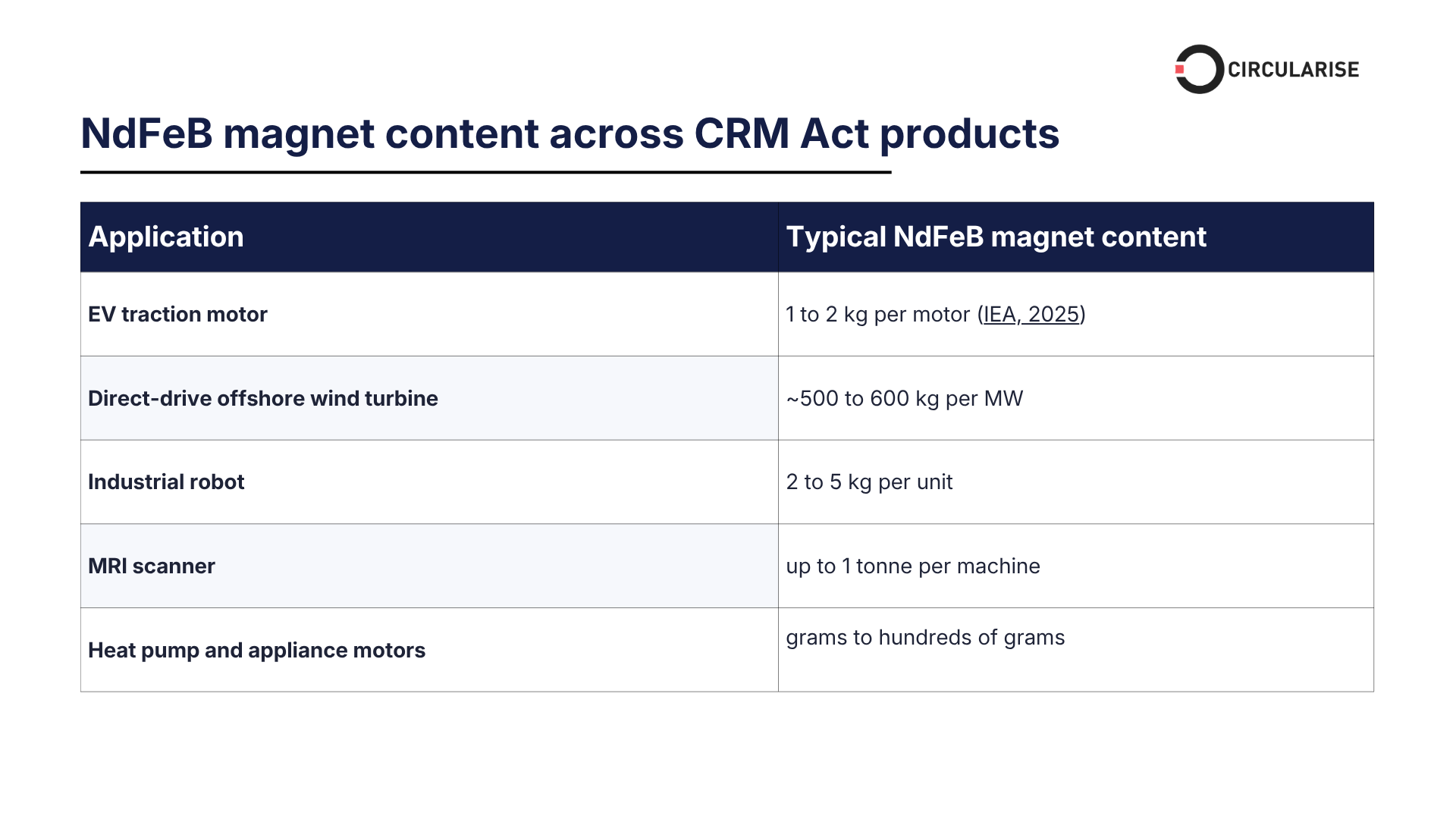
Three obligations apply to products containing NdFeB, samarium-cobalt (SmCo), aluminium-nickel-cobalt (AlNiCo), or ferrite magnets.
1. A physical label. A clearly visible, legible, and indelible label must be applied in two places: on the magnet-bearing component (e.g. motor, generator, magnet assembly) and on the finished product. The magnet's identity must stay with the part if the component is removed for repair or recycling, so OEMs can't push the component-level label down to Tier 1 suppliers. They hold direct legal responsibility for the product's entry into the EU market. The label identifies which of the four magnet types the product contains and signals the existence of a digital record.
2. A digital data carrier. Each product must carry a data carrier (typically a QR code or RFID tag) linked to a structured digital record. The record holds a unique product identifier, the manufacturer's name and contact, the weight, location, and chemical composition of each magnet, any coatings or adhesives used, and end-of-life removal instructions. It must remain accessible for the product's useful lifetime plus 10 years after end of life.
3. Recycled content disclosure. Products with permanent magnets over 0.2 kg must disclose the share of neodymium, dysprosium, praseodymium, and terbium from post-consumer waste. That catches every EV traction motor, most direct-drive wind generators, and most large industrial motors.
Non-compliance triggers national-level penalties and market withdrawal. There is no soft start.
The common thread: one data layer
Both halves of the CRM Act ask the same question of the same suppliers: where did this material come from, what's in it, who handled it, and how much of it is recycled? The Battery Regulation asks the same of cobalt, lithium, nickel, and graphite. The Battery Passport (mandatory from 18 February 2027) is the digital container designed to hold those answers for batteries. For permanent magnets, the equivalent answers will need to live in the data carrier and digital record set out in the CRM Act, applying from Q1 2028.
However, the two regulations engage at different depths in the supply chain, and that affects how companies need to prepare. A basic Battery Passport can often be assembled from data the manufacturer already holds, plus what their tier 1 suppliers can self-report. The CRM Act's percentage requirements take that shortcut away. You can't evidence a 10% share of domestically extracted material, or the recycled fraction of neodymium in a magnet, without verified data flowing in from the extractor, processor, or recycler that actually handled it. Self-attestation can't produce those numbers.
The data sets overlap heavily. Building one supplier data infrastructure that serves both regulations is the only economically defensible path.
Timeline: what’s ahead
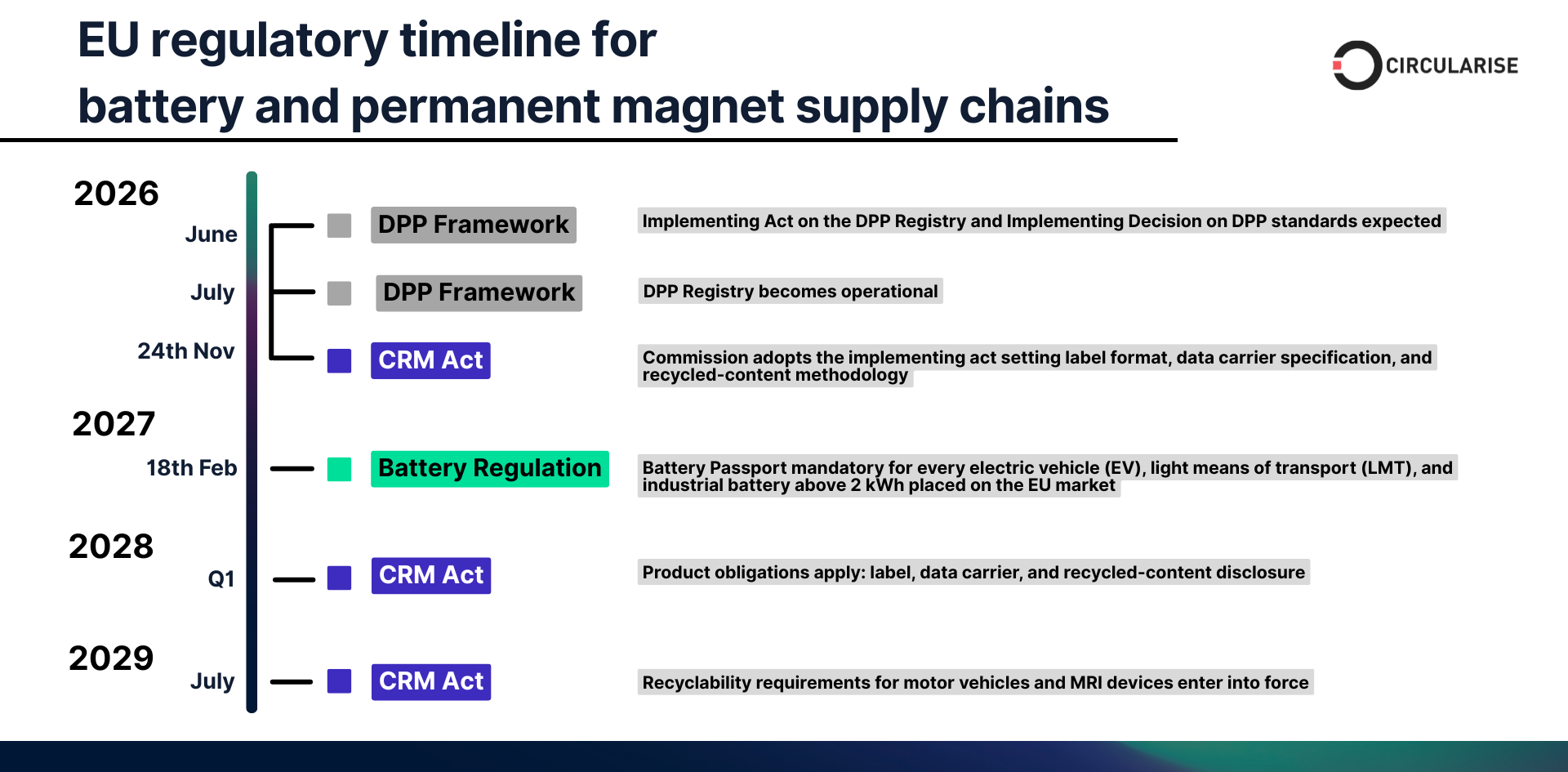
The first deadline that bites is the Battery Passport on 18 February 2027. From our experience, a fully implemented and integrated battery passport system, plugged into existing IT infrastructure, can take up to 6 to 9 months from kick-off to a passport ready to go live, depending on the organisation's digital readiness and maturity. And the Battery Passport itself is not just a QR code on a battery. Product identifiers need to be collected, data verified, and access rights and lifecycle updates defined inside a functioning digital system before the legal deadline. Some data will be static, some battery-specific, some restricted, and some only applicable when relevant obligations are triggered.
All of that assumes the upstream supplier work is already underway: suppliers signed up, data scope defined, data exchange standards agreed, and verified data flowing in from cell producers, material refiners, and rare earth processors.
None of that comes together overnight, and it sits on top of the system build itself. The 18 February 2027 deadline means you need to be in motion well before mid-2026. The CRM Act's Q1 2028 product obligations sit on the same data layer for the magnet stack, with a similar runway. For anyone not already started, the time available is short.
Checklist: what to do to satisfy both the CRM Act and the Battery Passport
Most companies in scope of the CRM Act are also in scope of the EU Battery Regulation, either through battery materials or the wider supply chain due diligence obligations. Each regulation has its own readiness checklist. The data backbone underneath them is the same, but the artifacts you need to produce are different. Run through both. If any answer is "not yet" or "I don't know", that should be a red flag.
CRM Act readiness
- Supplier due diligence declarations (critical). Verified declarations from rare earth processors, magnet producers, battery material refiners, cell producers, and component assemblers on sourcing, responsible mineral policies, and applicable due diligence frameworks.
- Risk assessment documentation (critical). Supply chain risks linked to magnet inputs and battery materials: origin concentration, known human rights and environmental risks, export-control exposure, and supply continuity.
- Material flow traceability. How rare earth alloys, cathode and anode materials, and finished cells move from processor to producer to manufacturer to final product, batch by batch.
- Supplier data collection across the supply chain (critical). Technical, chemical composition, recycled content, due diligence, and environmental data covering both the permanent magnet supply chain and the battery materials supply chain.
- Set up the digital systems to produce the required outputs (critical). A compliant data carrier and digital record for magnet-bearing products, accessible for the product's lifetime plus 10 years.
EU Battery Passport readiness
- Set up a system to gather Battery Passport data in one place (critical). Consolidates required data fields for battery category (composition, supply chain, performance, durability, repair, end-of-life) into one place rather than scattered across PLM, ERP, LCA, and supplier portals.
- Integrate with a Battery Passport system including dynamic data transfer (critical). Live data flowing into the passport from upstream supplier systems, production systems, and downstream partners, rather than a one-off data dump at issue time.
- Due diligence data collection (critical). Prepare traceability, risk-management, third-party verification and public disclosure evidence for cobalt, lithium, nickel and natural graphite per Articles 47-50 of the Battery Regulation, applying from 18 August 2027.
- Recycled content tracking and calculation. Track and calculate the share of recycled cobalt, lithium, nickel, and lead in each battery against the regulation's recycled-content thresholds once Article 8 obligations apply to that battery.
- Carbon footprint data collection (critical). Collect activity data, material and energy inputs, emissions factors and supplier datasets needed to calculate the battery carbon footprint across raw material acquisition and pre-processing, manufacturing, distribution, and end-of-life.
- Carbon footprint calculation. Apply the Commission's PEF-based methodology to produce a verified product carbon footprint per battery model. The resulting carbon-footprint data are then made available through the item-level passport.
- Generate battery passports and QR codes (critical). Issue a unique Battery Passport per battery in scope with a machine-readable data carrier, accessible from 18 February 2027.
- Ensure carbon footprint and other Battery Passport data have been verified by authorised third parties (critical). Third-party verification of the carbon footprint and other regulated data points before each battery is placed on the EU market.
- Enable differentiated access and manage the lifecycle of the Battery Passport in parallel with the lifecycle of the battery (critical). Public, partner, customer, market surveillance authorities, Commission and persons with legitimate interest views with appropriate access controls, with data updates throughout the battery's life (production, use, second-life, end-of-life).
If you'd like to run through either of these with us and map where you sit on each item, get in touch.
Where Circularise fits
- The Supplier Data Collection (SDC) module runs structured multi-tier campaigns for rare earth, magnet, and battery material data.
- The CoC 360 module records batch-level chain of custody for critical raw materials, producing the auditable records both regulations rely on.
- The Digital Product Passport module produces EU Battery Passports, CRM Passports for permanent magnet products, EV Passports, and DCVPs off the same data layer.
Circularise has been a member of Catena-X since April 2022, with capability extending into the deeper supplier tiers (cathode and anode material, refining, mining) and the wind, industrial, and medical-device industries the CRM Act now covers.
Closing
The CRM Act is, in practice, the same data collection problem twice: once for batteries through the strategic framework, once for permanent magnets through the product-level rules. The Battery Regulation overlays its own Battery Passport requirement on top. Whichever side you sit on, the underlying supplier data work is the same, and to meet the regulatory deadlines, that work needs to be in motion in 2026.
Battery Passport: 18 February 2027. CRM Act product obligations: Q1 2028. The starting gun has already gone off.
If you want to walk through your CRM Act and Battery Regulation exposure and what it would take to close the data gap, talk to us.