
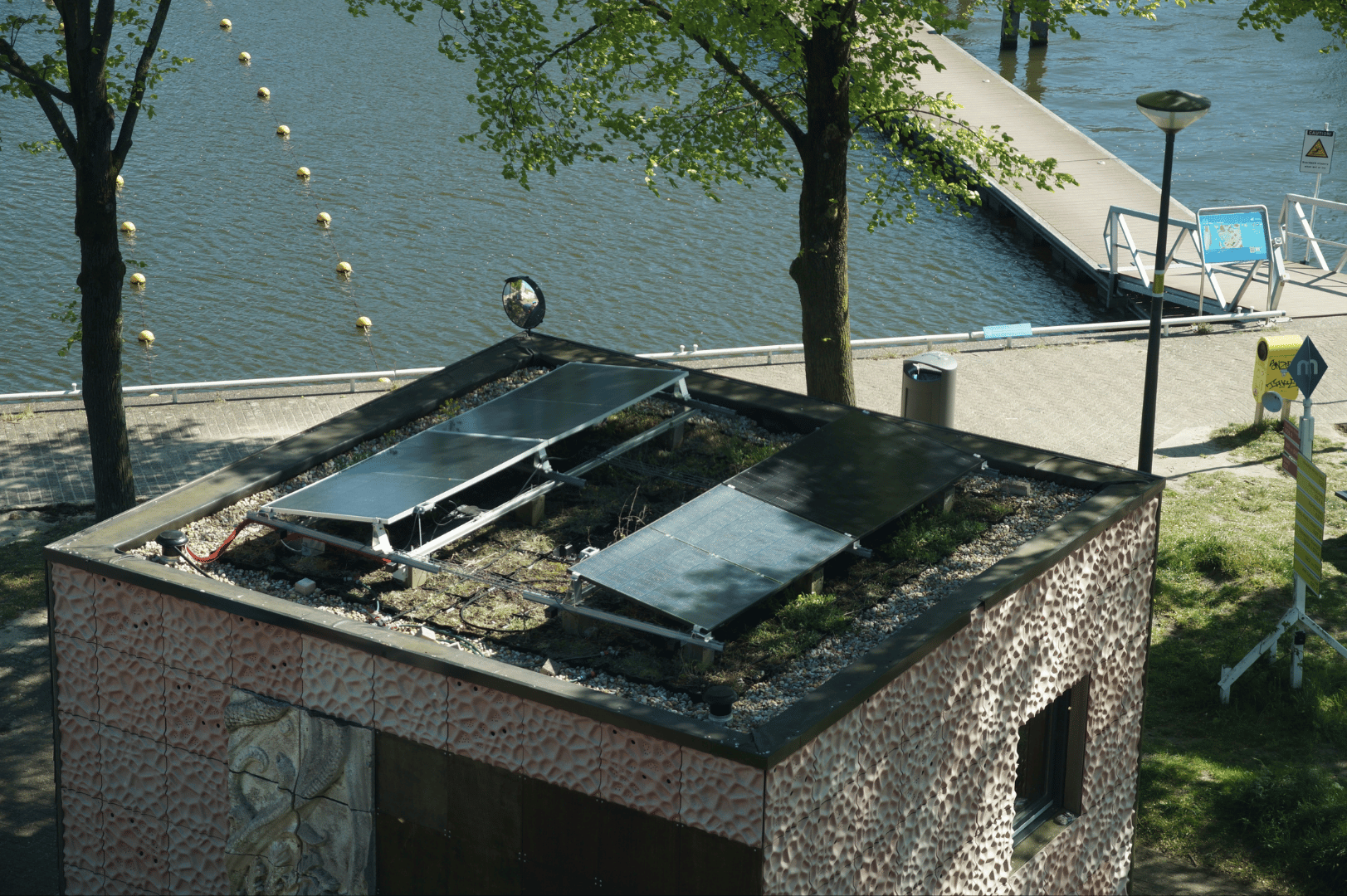
Amsterdam and The Hague, 8th October 2026: A solar module built to be taken apart and repaired is now generating electricity on the roof of the Innovation Pavilion at Marineterrein Amsterdam, and a QR code on site opens its digital product passport to anyone who scans it. The module is the latest prototype from FAIR-PV, a Dutch research project that ran from June 2024 to June 2026 with AMS Institute, Delft University of Technology, Biosphere Solar, and Circularise as partners. Circularise built the passport behind the code. The installation moves the module out of the lab and onto a working roof, where its output can be measured directly against conventional panels.
Opaque supply chains have left recyclers with no visibility into where a panel's materials came from or how it performed. Circularise and TU Delft spent the project's early phase working out what would have to be recorded to close that gap, mapping 176 data classes and 131 properties across the module's life: where the raw materials came from, which hazardous substances are present, how the module has performed, and what has been repaired along the way. Twelve interviews across the value chain produced the finding that shaped the design. For anyone deciding whether a panel is worth reusing, its condition today counts for more than the specification it shipped with.
Getting suppliers to hand that data over is the harder half of the problem. Circularise's patented Smart Questioning lets a company answer a specific question about a component without opening its entire record, so a supplier can confirm what a recycler or regulator needs to know without publishing its bill of materials to competitors.
The physical module itself is the work of TU Delft and Biosphere Solar. Conventional panels are sealed with Ethylene Vinyl Acetate (EVA) lamination, which bonds the glass under heat and leaves the layers chemically inseparable once the panel stops working. The FAIR-PV team replaced it with a liquid encapsulation layer, so the glass, silicon, silver, and aluminium can be recovered at the end.
"The full-sized liquid-encapsulated solar module can generate an extra 30 Watts of power from sunlight, compared to our previous modular design, without liquid. Moreover, at the end-of-life, we can retrieve, reuse, and recycle all the components of our solar PV module," said Urvashi Bothra, a postdoctoral researcher in TU Delft's Photovoltaic Materials and Devices (PVMD) group. More information on the research can be found here.
The technology is at an early stage. Amsterdam is the first time a full-size version has been tested outside a laboratory, and the rooftop readings over the coming months are what will show whether lab performance survives a Dutch winter.
"A passport is only worth something if somebody can actually reach it," said Maria Alejandra Leon, Research Manager, Circularise. "There is a module on a roof in Amsterdam with a QR code on it, and the data behind that code came from the manufacturers of each component. That is the difference between a compliance document and a record a recycler can still use when the panel comes down."
Photovoltaics do not yet carry a digital product passport requirement under the EU's Ecodesign for Sustainable Products Regulation (ESPR), which is being introduced product group by product group through to 2030. FAIR-PV's passport follows the data structure that framework sets out, so the groundwork exists before any requirement arrives. Biosphere Solar develops its design in the open, so other manufacturers can take the module and adapt it. Kameleon Solar, which specialises in building integrated photovoltaics, has already reworked part of its production line to handle the process. The data model Circularise built for FAIR-PV maps the solar value chain rather than this one module, so a manufacturer picking up the design can take the passport structure with it.
FAIR-PV was funded through the Dutch government's Knowledge and Innovation Agenda for Circular Economy (KIA-CE), with the Municipality of Amsterdam, the Province of South Holland, AGC, and the Amsterdam Economic Board as additional partners. AMS Institute has also published the consortium's own announcement.