


The European Union is driving the shift towards a circular economy through rapidly increased regulation for Digital Product Passports (DPPs), fundamentally reshaping how products are managed across their lifecycle. More than just a concept, the DPP is rapidly becoming a mandatory requirement across a growing array of sectors, signalling a profound change for businesses operating within, or looking to enter, the EU market.
At the forefront of compliance, DPPs are required by regulations such as the Ecodesign for Sustainable Products Regulation (ESPR). But other than the ESPR, numerous sector-specific EU regulations also require a product passport in a digital format. This article provides a comprehensive overview of the key EU regulations that mandate the implementation of Digital Product Passports and what data needs to be included in a DPP.
This article details the requirements and timelines for the following regulations:
- Ecodesign for Sustainable Product Regulation (ESPR)
- Battery Regulation
- Critical Raw Materials Act (CRMA)
- Detergents Regulation
- Toys Regulation
- End-of-Life Vehicle (ELV) Regulation Revision
- Construction Product Regulation (CPR)
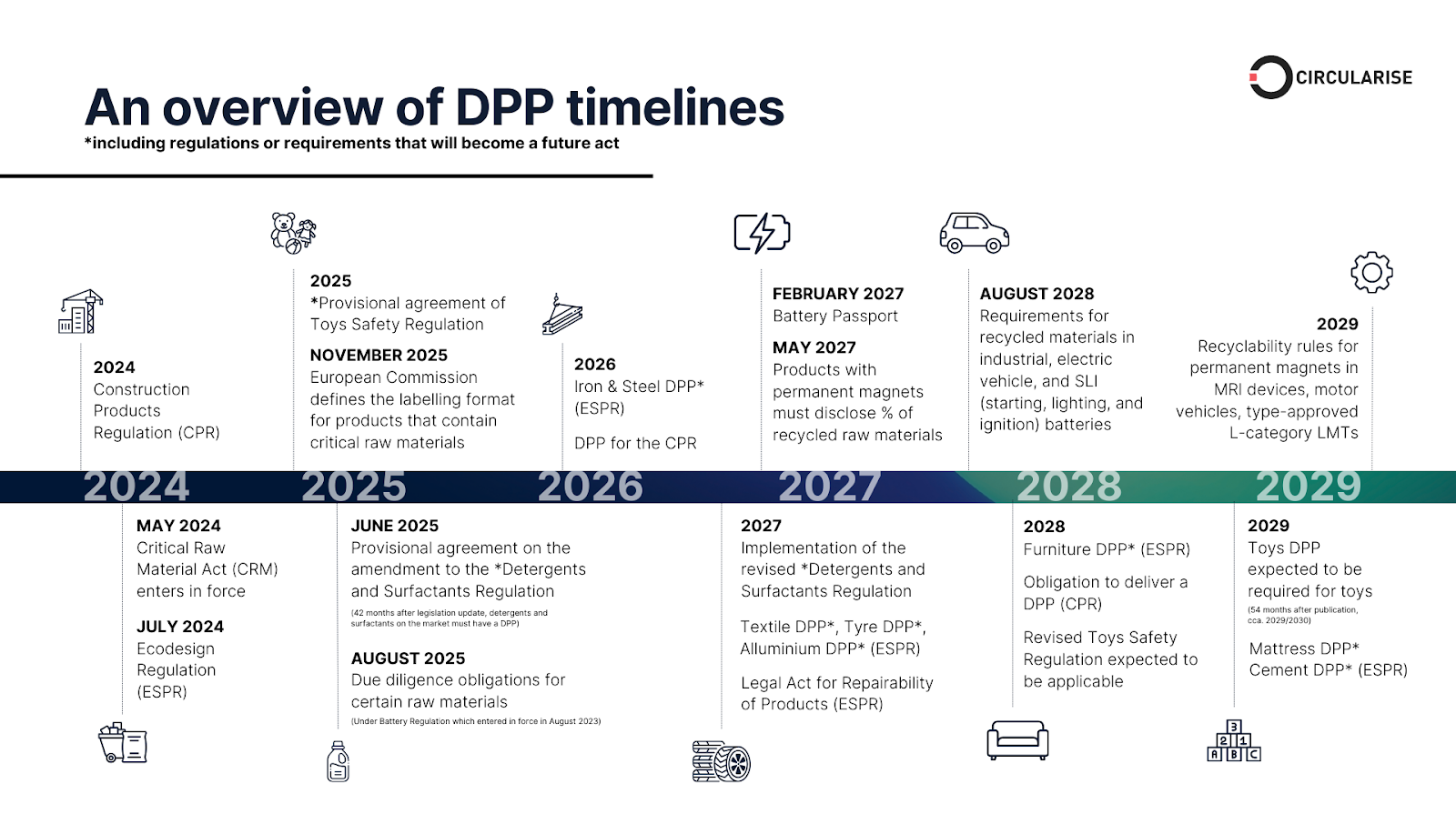
Understanding how these separate pieces are reshaping industrial and commercial practices is important for businesses to stay compliant, seize emerging market opportunities, and contribute to a more sustainable future.
Ecodesign for Sustainable Products Regulation (ESPR)
The Ecodesign for Sustainable Products Regulation (ESPR), part of the 2020 Circular Economy Action Plan and the European Green Deal, introduces the Digital Product Passport(DPP) to transform how products are tracked and managed across their lifecycle. Its primary goal is to enable circular business models by providing detailed, reliable product lifecycle data.
The DPP also increases transparency across complex global supply chains, giving manufacturers, recyclers, market surveillance authorities, economic operators, and consumers easy access to critical sustainability and product information. Interoperability is essential: the DPP must work with other EU digital systems, including customs databases and platforms like the European Chemicals Agency (ECHA). Ultimately, it empowers consumers and regulators to make informed, environmentally responsible decisions.
On 16 April 2025, the Commission rolled out the first set of products under the ESPR along with two new legal acts establishing horizontal rules. The initial focus covers final products such as textiles, furniture, tyres, and mattresses, as well as intermediate materials like aluminium, iron, and steel. These horizontal requirements standardise sustainability criteria and provide businesses with a clear framework to innovate, compete, and lead in the EU’s rapidly evolving circular economy.
What are the DPP requirements for ESPR?
A distinctive aspect of the ESPR is its emphasis on life-cycle data and product-level granularity, which goes beyond typical traceability measures. This level of detail enables a deeper understanding of a product’s environmental impact throughout its entire life. To comply with the ESPR, the DPP must contain comprehensive data across the following categories:
- Product identification
- Performance information
- Substances of concern
- Instructions for use, maintenance, and end-of-life treatment
- Sustainability information on recycled and renewable material content, and details on microplastic release
- Modularity and repairability
- Recyclability and circularity
Companies are also required to justify any decision to withhold information they mark as confidential, ensuring a balance between transparency and commercial protection.
Ecodesign for Sustainable Products Regulation (ESPR) timeline and milestones
The ESPR lays the groundwork for the development of future sector-specific Digital Product Passports(DPPs). Its broad scope ensures consistency across various product categories while allowing for tailored requirements through delegated acts. The regulation will be rolled out in stages, with clear timelines for both product-specific and horizontal requirements. Each act will specify the necessary data fields, reporting formats, and methodologies for every product group, ensuring that regulatory expectations match real-world industry practices.
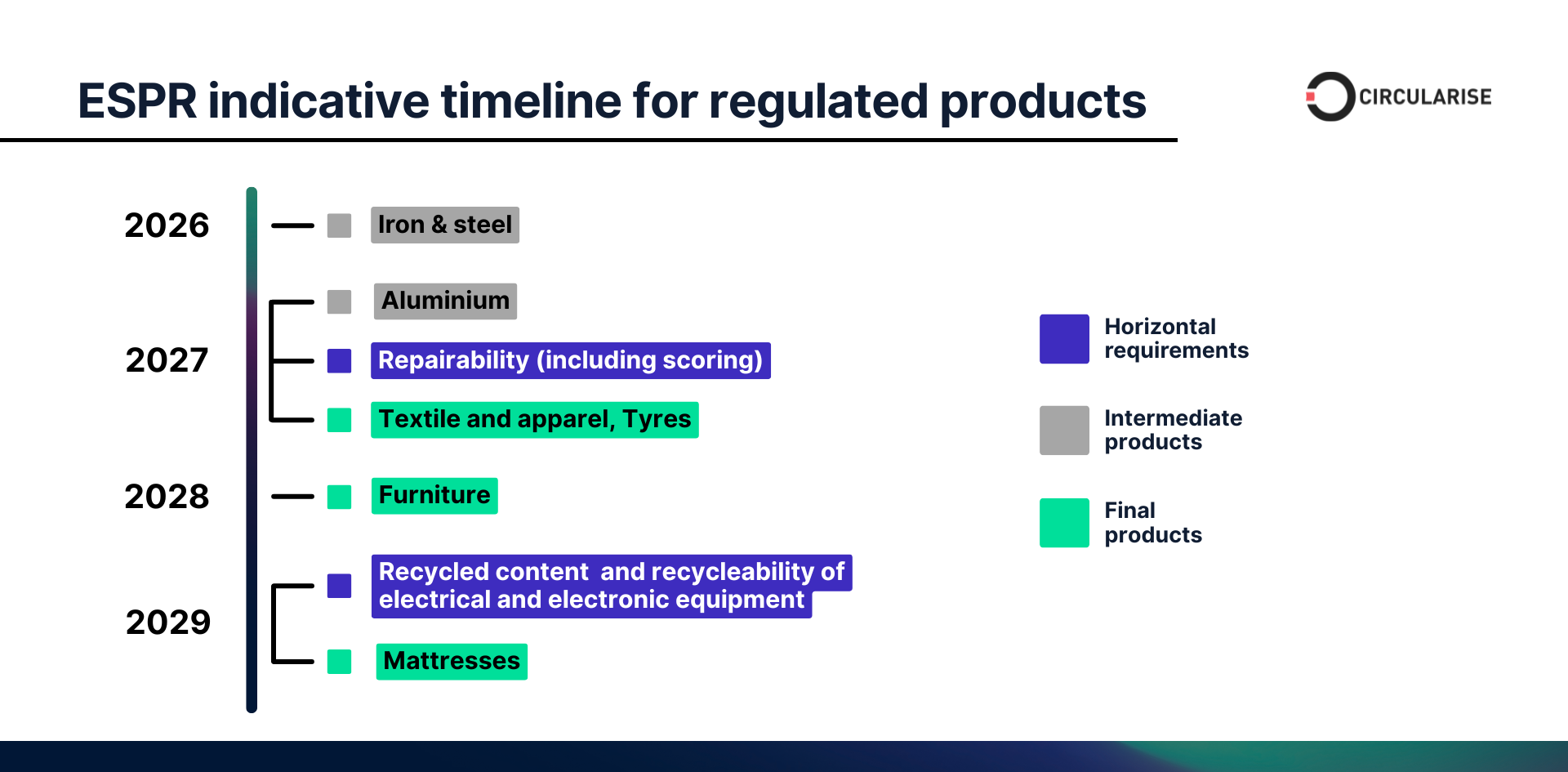
From 2026, ESPR begins with iron and steel, focusing on emissions, energy efficiency, and resilience. In 2027, aluminium, textiles, and tyres join, with measures for secondary materials, longer product lifespans, and improved recyclability. Repairability rules for electronics are also introduced. By 2028, furniture regulations target resource use and environmental impact, and in 2029, mattresses and electronics face rules on durability, recyclability, and recycled content.
Battery Regulation
The European Union is driving a profound modernisation of its legislative framework for batteries in order to establish a highly resource-efficient and competitive economy. Central to this transformation is the EU Battery Regulation, which introduces a specialised form of the Digital Product Passport (DPP) — the battery passport.
A Battery Passport is a comprehensive digital document designed to store critical data throughout a battery's entire lifecycle. While sharing core characteristics with the general DPP under the ESPR, battery passports are meticulously tailored to meet the unique requirements of the battery industry and its complex value chain.
Recognising the complexity of industry-wide compliance, the EU has opted for a phased implementation approach. This gives businesses space to update their internal systems, workflows, and reporting processes to develop critical digital tools that will underpin compliance.
In parallel, it supports the creation of a robust third-party verification infrastructure to ensure the reliability of shared data. This phased approach also enables stakeholders to gather, structure, and validate the complex datasets required for full regulatory alignment — a strategy already being put into practice by battery consortiums piloting Digital Product Passports.
What are the DPP requirements for batteries?
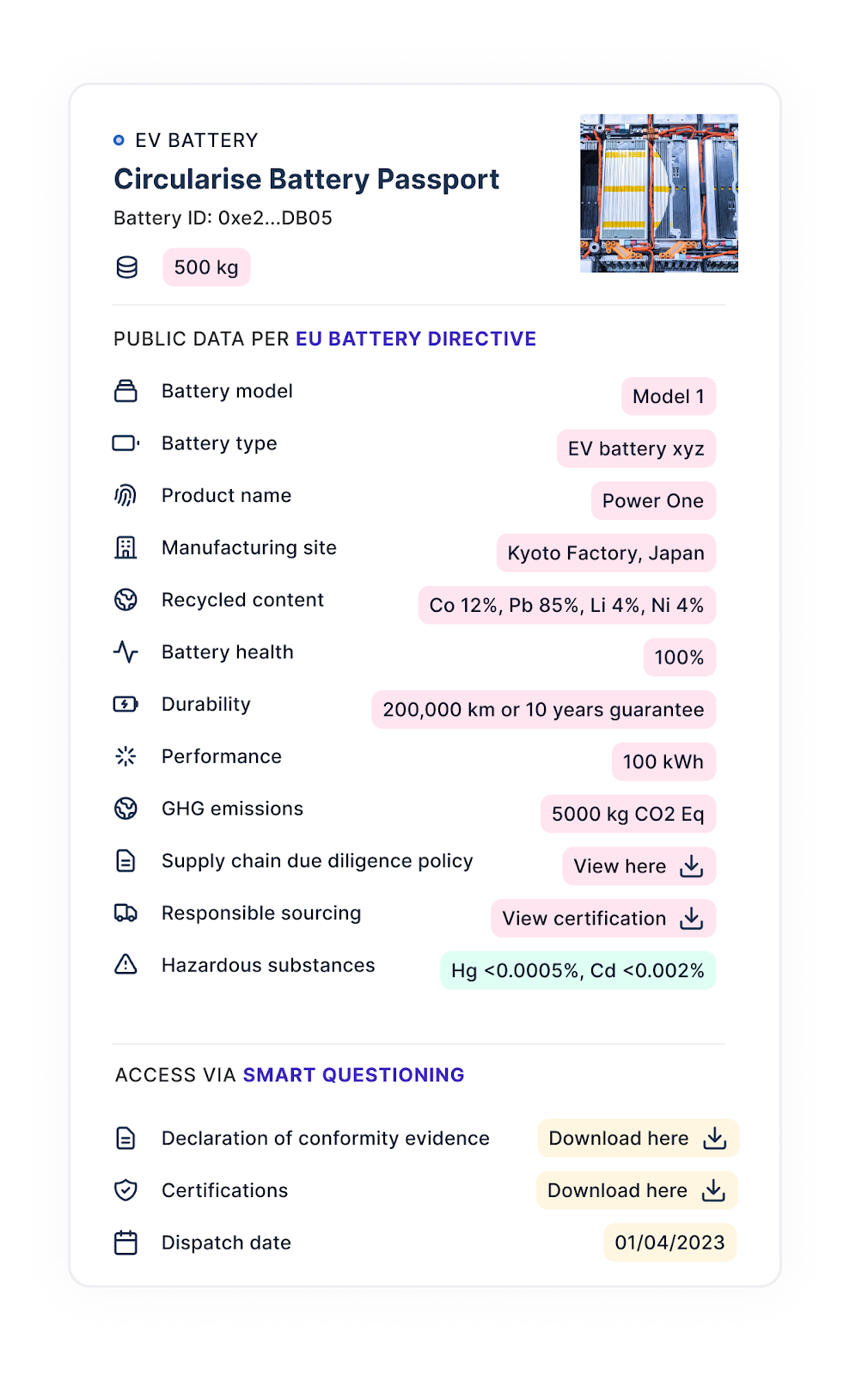
The Battery Passport must include key information to ensure traceability and performance transparency, such as:
- A unique product identifier for access to the battery passport, provided via a QR code printed or engraved on the physical battery
- Basic specifications, including type and model
- Lifecycle data on performance and durability, updated by parties handling repair or repurposing
- The carbon footprint specific to the manufacturing site and battery batch
- Technical documentation on electrochemical performance and durability, including methods used to collect the data, ensuring the battery meets minimum operational and efficiency standards throughout its lifespan
Battery Regulation timeline and milestones
The EU Batteries Regulation (EU 2023/1542) came into force on 17 August 2023, introducing a phased implementation of its provisions, with several measures starting on February 18, 2024. The regulation fully replaced and repealed the previous Battery Directive (2006/66/EC) on 18 August 18 2025, and Member States must also lay down rules on penalties.

In 2026, two key milestones follow. By 26 July 2026, the deadline for publishing Guidelines has been extended by one year, and by 18 August 2026, the Commission must adopt an implementing act.
From 18 February 2027, a unique Battery Passport, retrievable via a QR code, will be mandatory for all Electric Vehicle (EV) and industrial batteries placed on the EU market with a capacity over 2kWh, regardless of their origin. This requirement extends to a wide range of battery types, including:
- Electric Vehicles (EVs) over 25 kg
- Light Means of Transport (LMT) under 25 kg
- Batteries intended for industrial uses (>5 kg)
- Portable batteries (≤5 kg)
- Starting, Lighting, and Ignition (SLI) automotive batteries.
Additionally, from 18 August 2027, the Omnibus IV due diligence obligations for battery supply chains are postponed by two years. The European Commission must review and report on the effectiveness of the Regulation by 30 June 2031.
Critical Raw Materials Act (CRMA)
Under the Critical Raw Materials Act, manufacturers placing specific products on the EU market must ensure these products carry a permanent magnet label and an associated Digital Product Passport (DPP). This obligation applies to a wide range of goods, which include:
- Motor vehicles
- Light means of transport (e-bikes, scooters)
- Magnetic resonance imaging (MRI) devices
- Wind energy generators
- Electric motors (standalone or integrated)
- Cooling generators and heat pumps
- Dishwashers, washing machines, tumble driers
- Vacuum cleaners and microwaves
- Industrial robots
What are the DPP requirements for critical raw materials?
The Digital Product Passport (DPP) under the CRMA must contain a unique product identifier, as well as the following information:
- Products must include a clearly visible, indelible label that indicates whether the product includes one or more permanent magnets, and if so, which type of magnet is used:
- Neodymium-iron-boron
- Samarium-cobalt
- Aluminium-nickel-cobalt
- Ferrite
- Name, registered trade name or trademark, and contact details (postal and email) of the responsible party
- For each permanent magnet in the product:
- Weight
- Location within the product
- Chemical composition
- Type of coatings, adhesives, or additives used
- Guidance for safe access and removal, including required tools, steps, and technologies
The DPP must be complete, accurate, and continuously updated throughout its lifecycle, and maintained for at least the typical lifetime of the product plus an additional ten years. Even in the event of insolvency or if the responsible party ceases operations within the EU, the DPP must remain accessible. Moreover, it must be compatible with the requirements outlined in the Ecodesign for Sustainable Products Regulation (ESPR) or other relevant EU legislation.
Critical Raw Materials Act (CRMA) timeline and milestones
The CRMA entered into force in June 2024. The rollout of the CRMA’s traceability and passport obligations is structured in phased stages, with both legislative and technical preparation underway.
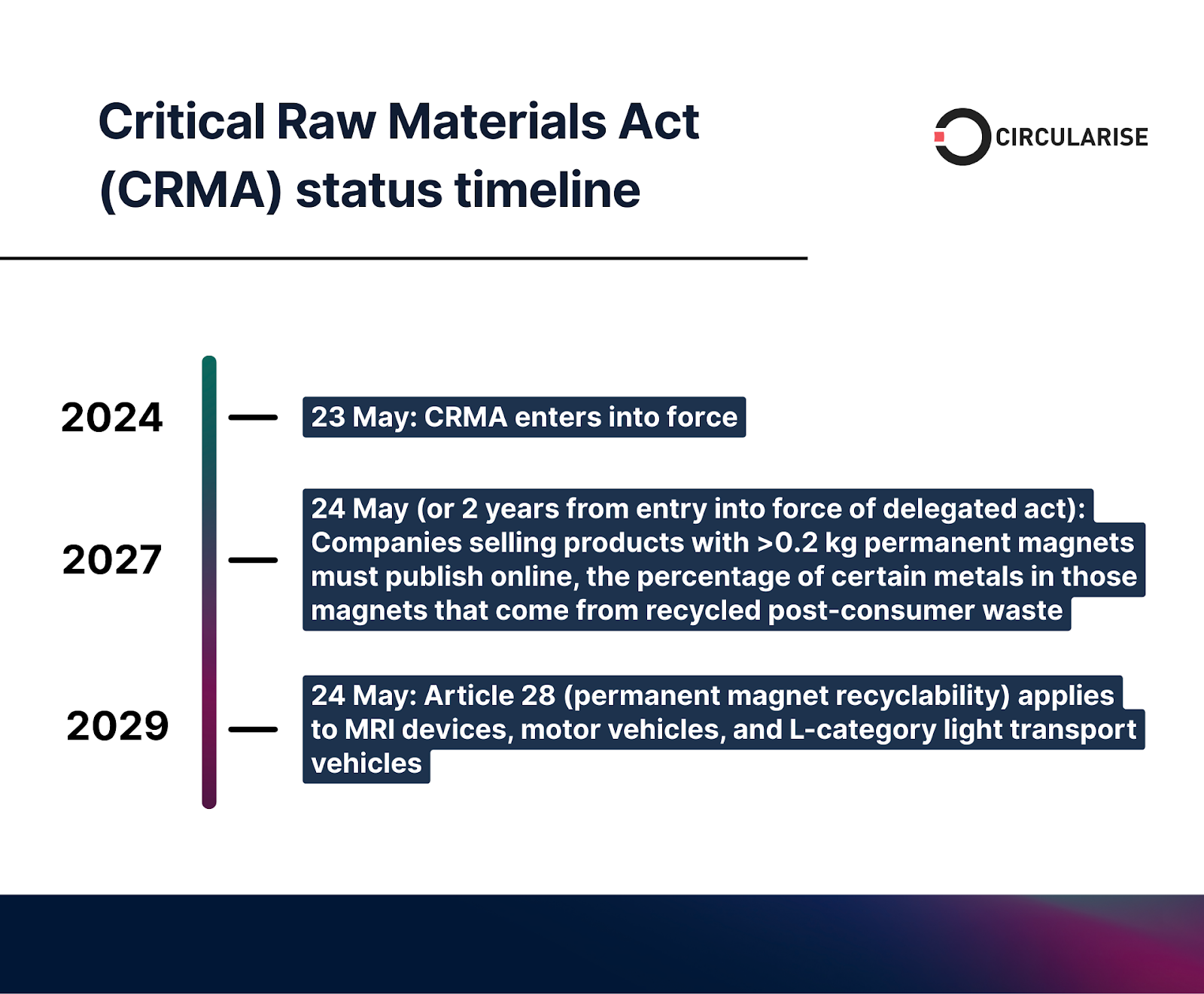
From November 2025, the Commission will adopt the format for permanent magnet labelling. From 24 May 2027, or two years from the entry into force of the relevant delegated act, products containing permanent magnets over 0.2 kg must disclose the share of critical raw materials recovered from post-consumer waste. And finally, from 24 May 2029, recyclability requirements for permanent magnets will apply to MRI devices, motor vehicles, and L-category light transport vehicles.