
The Hague and Tokyo, Nov 17, 2026: Circularise has entered into a joint demonstration project with Asahi Kasei Corporation and Furuya Metal Co., Ltd. to establish end-to-end traceability for recycled iridium (Ir) and ruthenium (Ru). The initiative will trace the material lifecycle from spent chlor-alkali electrodes through extraction and refining to newly manufactured electrodes. Additionally, the partners will evaluate issuing Digital Product Passports (DPPs) to securely maintain and communicate material provenance data across the value chain. For Circularise, this project extends proven traceability mechanisms developed for rare earth elements and permanent magnets under EU-funded research to the precious metals sector.
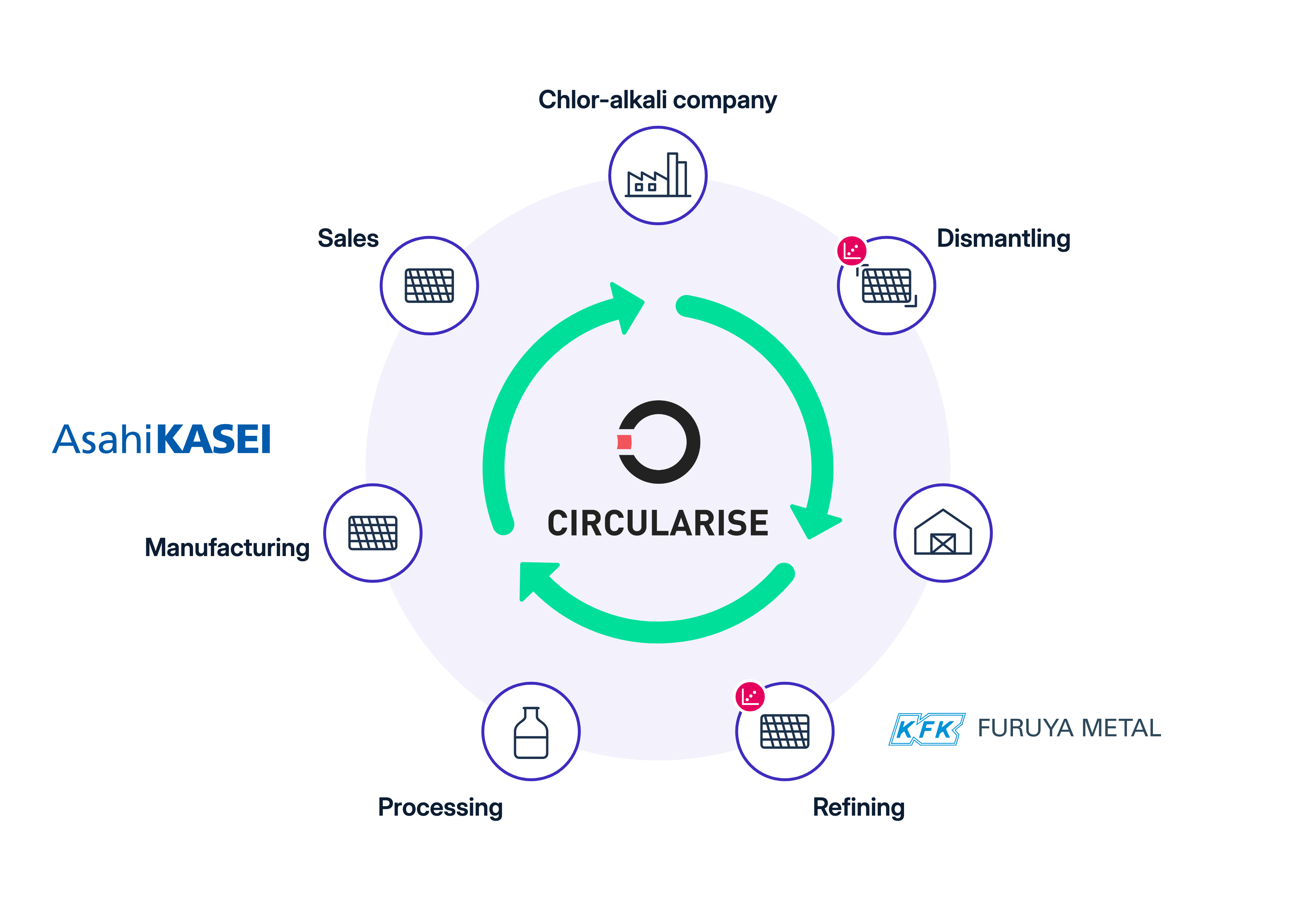
Iridium and ruthenium belong to the platinum group metals (PGMs), which are designated as critical raw materials by the European Union. These metals are essential components in chlor-alkali electrodes, electronics, and semiconductor fabrication, with expanding demand anticipated from clean hydrogen technologies such as proton exchange membrane (PEM) water electrolysers. Given constrained primary supply and market price volatility, high-purity metals recovered from end-of-life industrial products represent a vital strategic resource.
However, verifying recycled content and responsible sourcing presents significant technical and operational hurdles. Recycled metal ingots lack inherent markers of origin, while essential lifecycle data remains fragmented across multiple stakeholders, including collection agents, refiners, and processors. Because much of this supply chain data is proprietary, companies require secure data-sharing frameworks. Without a unified digital record, verifying responsible sourcing or validating circularity claims remains difficult, limiting opportunities to optimise material efficiency.
This joint initiative expands upon a 2025 recycling demonstration led by Asahi Kasei alongside industry partners including Nobian, Furuya Metal, and Mastermelt. The current project integrates digital infrastructure into the physical recycling loop. Furuya Metal contributes advanced capabilities in PGM refining, processing, and recycling, while Circularise provides its proprietary supply chain traceability software and privacy-preserving data exchange technology.
Building on nearly ten years of expertise in supply chain traceability, particularly with Critical Raw Materials (CRMs) such as Rare Earth Metals, Circularise is positioned to extend these capabilities to PGM traceability. The company has played a key role in numerous commercial initiatives and publicly funded programs, including the CSyARES project, where it led the project with the aim of enabling transparent and circular Rare Earth value chains across Europe.
"Our experience with rare earth magnet traceability showed that successfully closing the loop of a critical material comes down to secure data exchange in a geopolitically sensitive multi-stakeholder environment, where process optimisation and circularity can be an effective de-risking strategy to price volatility and supply chain disruptions. This data is especially important since we are talking about small volumes of material inside of larger products and installations that can easily get lost,” said Jordi de Vos, Co-Founder, Circularise. “Similar to that case, iridium and ruthenium change hands and borders several times between a used electrode and a new one. With Asahi Kasei and Furuya Metal, we can enable a resilient and stable supply of platinum group metals for the chlor-alkali process."
This project builds upon established relationships between Asahi Kasei and Circularise, who together conducted an initial proof of concept last year using a simulated recycling scenario. The result showed that the Circularise platform could securely trace precious metals recovered from end-of-life electrodes and reused in new products. In 2022, Asahi Kasei participated as a key material supplier in Circularise’s ISCC PLUS mass balance pilot. Following the successful pilot, Asahi Kasei Corporate Venture Capital (CVC) completed a strategic investment in Circularise.
Looking ahead, the participating entities anticipate extending these applications beyond chlor-alkali manufacturing to encompass hydrogen electrolysis systems and additional sectors dependent on critical minerals. By integrating advanced material recovery with robust digital traceability, this strategic collaboration establishes a scalable model designed to safeguard access to critical raw materials and facilitate the transition toward a circular economy.