


Author
Ziva Buzeti
Policy Researcher

Lorem ipsum dolor sit amet, consectetur adipiscing elit. Suspendisse varius enim in eros elementum tristique. Duis cursus, mi quis viverra ornare, eros dolor interdum nulla, ut commodo diam libero vitae erat. Aenean faucibus nibh et justo cursus id rutrum lorem imperdiet. Nunc ut sem vitae risus tristique posuere.

Table of contents
Text LinkText Link

Introduction

For global businesses, a single percentage point in a tariff can translate to millions in unexpected costs. Yet, in today’s volatile trade landscape, that’s precisely the risk companies face daily. From US administration changes and geopolitical tensions to the enduring complexities of Brexit, trade policies are no longer static. They are dynamic, unpredictable, and increasingly wielded as political tools. It’s no wonder that 95% of companies now cite tariffs and geopolitics as major supply chain decision drivers.

The core problem? A critical lack of visibility into multi-tier supply chains. Most companies simply don’t know the true country of origin for all their components — the fundamental data point for determining tariffs. This opacity forces them into a reactive stance, where guesswork replaces strategy.

In this new era, traditional supply chain management is insufficient. True cost control and compliance stem from digital traceability, which enables data agility to navigate tariff complexities efficiently. It’s the essential tool for operational de-risking, allowing companies to build resilient, multi-sourced supply chains without fully decoupling from key markets. It provides the data to manage risk, not just avoid it.

Overpaying tariffs and fines: The high cost of poor supply chain visibility

To understand the solution, we must first quantify the problem. The costs of poor visibility are twofold — direct financial leakage and operational drag.

How poor visibility leads to tariff overpayment and fines

Companies consistently overpay tariffs because they cannot prove that a product's true origin qualifies for a lower duty or a Free Trade Agreement (FTA). As a result, they default to the higher "Most Favoured Nation" (MFN) rate to avoid compliance risk — a costly form of insurance.
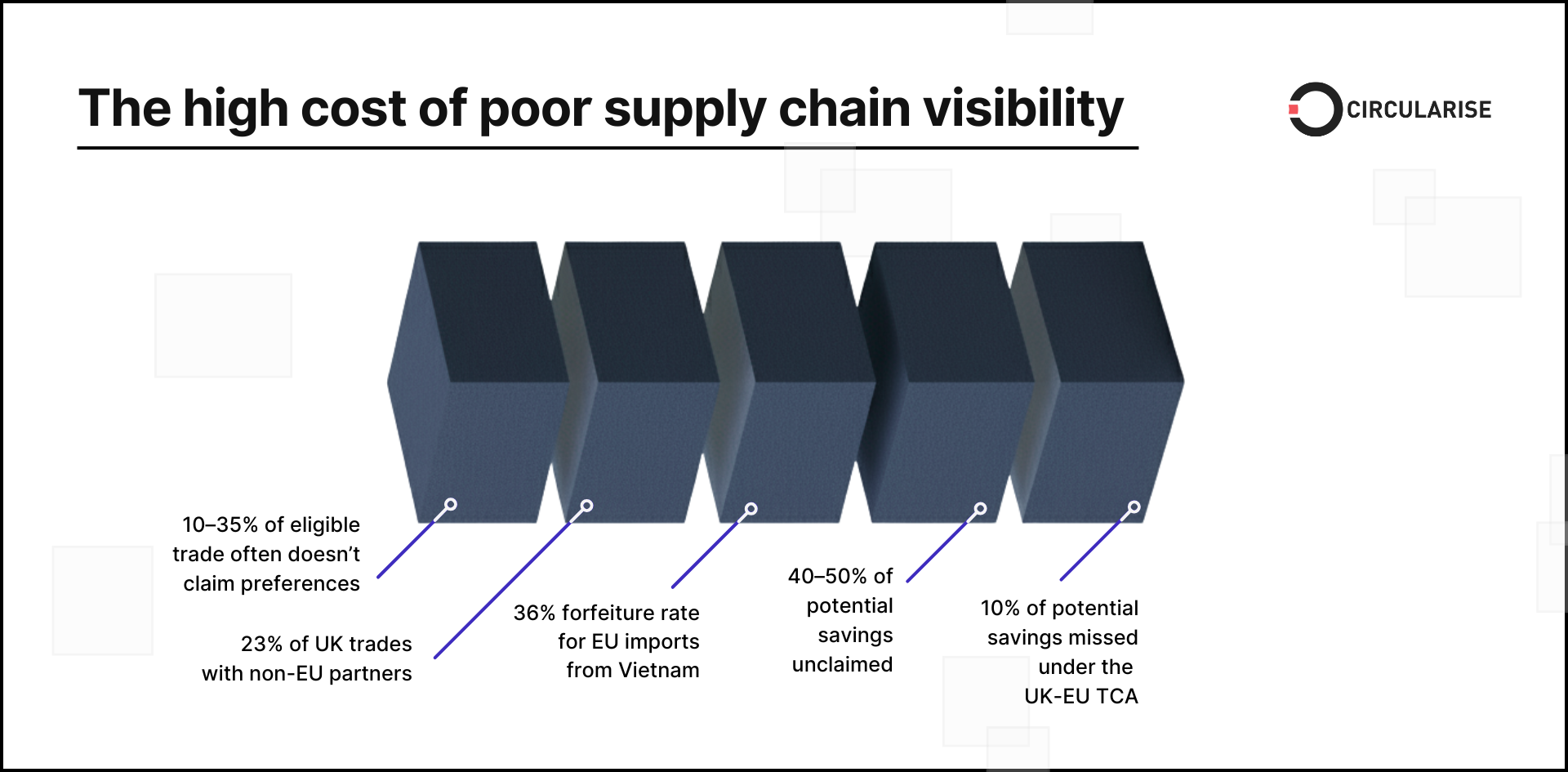
Figure 1: Visual highlighting the cost of poor supply chain visibility, showing how missed preference claims can leave 10–50% of potential tariff savings unclaimed across key trade lanes (including the UK–EU TCA and EU–Vietnam trade).

The evidence is stark. Official statistics show persistent under-utilisation of FTAs, leaving millions in duty savings unclaimed. Roughly 10–35% of eligible trade often doesn’t claim preferences, including: 

  • ~23% of UK trade with non-EU partners, 
  • ~36% forfeiture rate for EU imports from Vietnam, 
  • 40–50% of potential savings unclaimed in some complex agreements.

This isn't just savings left unclaimed. It's a strategic blind spot that directly attacks your bottom line. On the other hand, the crushing penalties for non-compliance often cost multiples of the original duty owed. Either leverage data to claim every dollar back, or wait for the fine to arrive.

The operational drag of manual customs compliance

Manual customs compliance creates a constant operational drag. The process of gathering origin data is slow, error-prone, and requires a significant amount of manpower. Every tariff change or audit triggers a frantic, weeks-long scramble through emails and spreadsheets — diverting resources from strategic work and causing costly delays.

Think of your company's profits as a bucket of water. On one side, the leak of “unclaimed duty” is steadily draining your cash. On the other hand, a second leak of “operational drag” wastes precious time and productivity.

Digital traceability is the plug that stops both leaks, securing your profitability and freeing your team to focus on growth.

Figure 2: Illustration of the two hidden costs of manual customs compliance, unclaimed duty and operational drag, shown as “leaks” that drain company profits.

Three pillars of tariff management: Classification, valuation, and origin

Navigating international tariffs is built on three fundamental pillars: Classification, valuation, and origin. Most supply chain opacity leads to errors and overpayment in these three areas. Digital traceability through a Digital Product Passport (DPP) can provide the precise, verifiable data needed to master each one.

1. Classification: Master HS code accuracy for customs compliance

Every product traded internationally is identified by a Harmonised System (HS) code—a standardised numerical classification. Getting this code wrong is a primary source of customs trouble. 

The code determines the duty rate, and misclassification can lead to:

  • Overpayment: Using a code with a higher duty rate.
  • Underpayment: Using a code with a lower rate, resulting in hefty fines, penalties, and back-paid duties with interest upon audit.
  • Delays: Customs officials withholding shipments for inspection and verification, disrupting just-in-time manufacturing and causing stockouts.

The challenge lies in the fact that modern products, especially electronics and complex goods, are made of hundreds of components. Manually tracking the precise material composition to find the correct HS code is nearly impossible without direct access to supplier data.

2. Valuation: Ensure accurate duty calculation and transfer pricing compliance

Customs duties are calculated as a percentage of the product's assessed value. The rules for determining this value are complex (the "transaction value" is just the start). Problems arise from:

  • Transfer pricing: the price one subsidiary charges another for components must be an "arm's length" price. If customs authorities deem it too low (to reduce duties), they can revalue the goods, leading to back charges.
  • Royalties and licenses: Fees paid for intellectual property related to imported goods must often be added to the value.
  • Assisting components: The cost of tools, moulds, or materials supplied free of charge to the manufacturer can be included in the value.

Without transparency into the financial flows and agreements throughout the supply chain, accurately reporting and defending the declared value is a major risk.

3. Origin: Prove FTA eligibility and comply with rules of origin

“Country of Origin” is defined by complex Rules of Origin (ROO), which determine eligibility for preferential 0% tariff rates under FTAs. The problem isn't the rules themselves — it’s proving compliance. Without visibility into Tier 2 and 3 suppliers, proof is anecdotal, and companies default to paying higher MFN rates, leaving massive savings on the table.
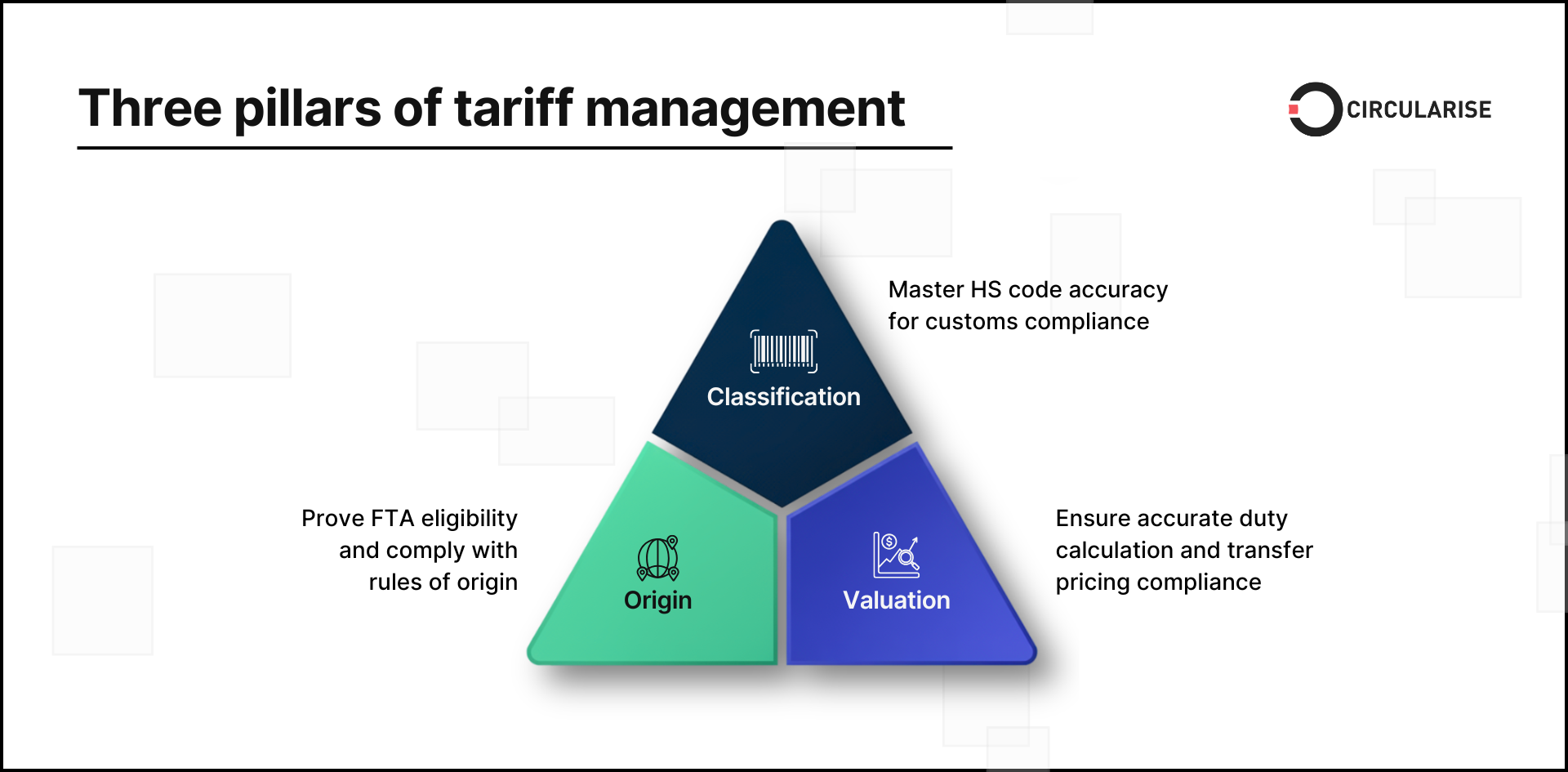
Figure 3: Diagram summarising the three pillars of tariff management, classification (HS code accuracy), valuation (accurate duty calculation and transfer pricing), and origin (rules of origin and Free Trade Agreement eligibility).

Mastering the tariff management with the supply chain traceability enabled by DPPs

The Digital Product Passport (DPP) is evolving from a conceptual sustainability initiative into a practical framework that can enhance tariff and supply chain management. Mandated by the EU’s Ecodesign for Sustainable Products Regulation (ESPR), the DPP has the potential to serve as a verifiable, digital record of origin across complex, multi-tier supply chains—helping companies move away from fragmented, retrospective origin data toward a more connected, data-driven future.

1. Building a verified Bill of Materials (BOM) trail across the supply chain

A DPP does not simply state an origin; it proves it. As raw materials and components move through each manufacturing step, their journey is recorded on the DPP. The DPP can store specific data points, such as:

  • The origin of materials of components from fragmented supply chains.
  • The geographic location of each transformation event.
  • The nature of the work performed (e.g., "Component A from Malaysia was assembled with Component B from Mexico at Facility X in the USA.")

As raw materials and components transit through manufacturing steps, each transformation event, location, and processing detail is securely logged in the DPP using interoperable, machine-readable standards. This creates an auditable and transparent trail that can be traced all the way back to its source. 

3. Strengthen customs compliance and minimise risk

With verified data embedded in a DPP, importers can more effectively substantiate preferential tariff claims through accessible and traceable certificates of origin. This reduces the administrative effort required for manual documentation and helps minimise the risk of penalties during customs audits — enhancing compliance readiness and improving the efficiency of cross-border trade.

4. Strategic link: Using DPPs for friend-shoring and navigating global tariffs

Geopolitical shifts are prompting companies to reconsider where and how they source materials. While future DPP systems could support scenario modelling and predictive tariff planning, today’s practical value lies in establishing visibility into current sourcing data and eligibility baselines.

Traceability provides a fact-based view of where materials originate and how they qualify under existing FTAs. This clarity empowers companies to make informed, data-driven sourcing decisions, supported by verifiable information rather than assumptions—helping them act strategically in response to evolving trade dynamics.

The power of the DPP is that it doesn't just address the three pillars in isolation; it unifies them. It creates a single, shared, and verifiable source of truth that tells the complete story of a product:

  • What it is (Classification data)
  • What it’s made of (Material composition for Classification and Origin)
  • Where it's been (Journey data for Origin and Valuation)
  • Who’s handled it (Entity data for Valuation and Origin)

Delivering this comprehensive transparency transforms tariff and origin management from a complex cost centre into a streamlined, resilient advantage. To fully realise this potential, companies must invest in interoperable, secure, and regulatory-compliant DPP solutions, mindful of the operational changes and data governance required.
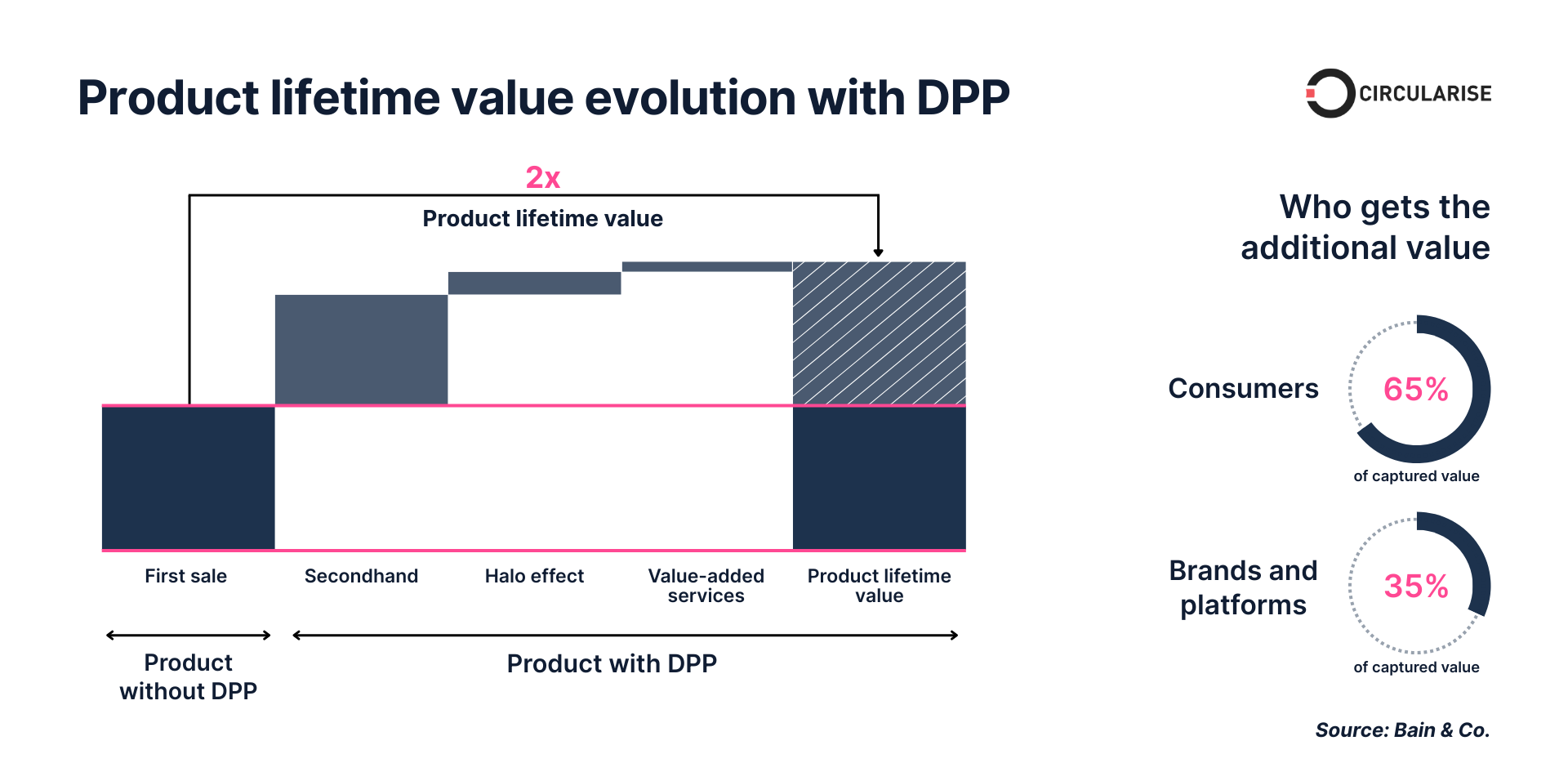
Figure 4: Infographic showing how Digital Product Passports (DPPs) can increase product lifetime value by enabling secondhand resale, halo effects, and value-added services, and how the additional value may be captured by consumers (65%) versus brands and platforms (35%). Source: Bain & Co.

Future-proof your operations: Traceability for strategic tariff planning

Around 60% of U.S. companies have experienced a 10–15% increase in logistics costs over the past year, primarily due to the ongoing tariffs and associated trade tensions. While these tariff escalations largely originated from U.S. policy decisions aimed at protecting domestic industries, they have in turn triggered reciprocal EU measures with direct operational and strategic implications for EU companies.

For example, the U.S. imposed a 50% tariff on steel and aluminium imports, both of which are key materials regulated under the EU’s Ecodesign for Sustainable Products Regulation (ESPR) that requires Digital Product Passports (DPPs) for traceability. Additionally, automotive exports from the EU to the U.S. face tariffs of around 15%, impacting major manufacturers and the intricate auto parts supply chain. These tariffs amplify costs for raw materials and manufactured goods, increase complexity in customs declarations, and heighten the risk of non-compliance penalties.

From a supply chain perspective, sectors such as steel manufacturing, aluminium processing, and automotive have become particularly vulnerable to tariff volatility and customs delays. This vulnerability underscores the enhanced value of traceability tools like DPPs. With DPP integration, companies can generate a robust, verified digital record — tracing material composition, origin, and transformation events — which significantly supports compliance with Rules of Origin (ROO). This traceability not only aids in tariff classification and preferential treatment claims but also streamlines audits and mitigates the cost risks associated with border inspections and tariff disputes.

Consequently, leveraging DPPs for tariff-impacted goods transforms tariff management from a reactive burden into a strategic opportunity. It empowers businesses to proactively manage cross-border compliance, optimise sourcing decisions, and confidently engage in friend-shoring strategies encouraged by geopolitical trade shifts. Understanding which supply chain segments — such as steel and automotive — are most exposed enables companies to target DPP implementation where it delivers the highest risk mitigation and cost-saving benefits.

Traceability isn't just about saving money today; it's about building strategic resilience for tomorrow. Here is a quick diagnostic to uncover hidden tariff costs. Ask your compliance team:

  1. What is our current FTA utilisation rate across key trade lanes?
  2. How many person-hours does it take to respond to a single customs inquiry or audit?
  3. How quickly can we model the impact of a new 15% tariff on a critical component?
  4. Do we have verified country-of-origin data for all components, including those from Tier 3 suppliers?

With a digital model of your supply chain, you can run "what-if" simulations before changes happen. Model the impact of a new tariff and develop contingency plans instantly, moving from reaction to strategy.

When changes happen, companies with a supply chain traceability can re-validate origin and re-classify products in days, not months. This ensures continuous customs clearance and supply — a definitive competitive advantage over stalled competitors.

The same data used to prove origin for tariffs is directly applicable to claiming benefits under the various legislation, such as the US Inflation Reduction Act (IRA) or EU Green Deal, future-proofing your investment far beyond just customs.

Why you should choose a traceability solution

Implementing traceability is an investment in resilience. The right solution should create clarity, not complexity. It must be:

  • Secure, verifiable, and confidential
    This is non-negotiable. Solutions must utilise advanced privacy-preserving technologies, such as zero-knowledge proofs (as Circularise’s platform does), to ensure data is immutable and trustworthy while keeping supplier IP fully protected. You can’t build a multi-tier network without this trust.
  • Built on open standards and integrable
    Technology must be an enabler, not a barrier. The right system must seamlessly integrate with your existing ERP and PLM systems to leverage current investments. Furthermore, it must be built on open standards (GS1, W3C), ensuring interoperability, avoiding vendor lock-in, and future-proofing your investment. Circularise’s platform is designed on this very principle, ensuring flexibility and long-term viability.
  • Scalable across the entire supply chain
    The ultimate value of a DPP is realised through network effects. This requires a platform designed to engage suppliers of all sizes and levels of digital maturity, deep into your supply chain (Tier 2, 3, and beyond) — not just your primary Tier 1 partners. The value is in the network effect, where every participant contributes to and benefits from a shared, verified source of truth, creating a stronger and more transparent ecosystem for all.

Conclusion

The volatile geopolitical landscape has shattered traditional, reactive tariff management. The cost of supply chain opacity is now a direct attack on the bottom line, resulting in unclaimed FTA savings, punitive fines, and operational drag. Without verifiable, multi-tier data, the pillars of customs—classification, valuation, and origin—are built on sand, making traditional methods a significant strategic risk.

Digital traceability, through a Digital Product Passport (DPP), is the essential upgrade. It transforms tariff management from a cost centre into a strategic advantage. The true power lies not just in generating audit-proof certificates but in proactively modelling the impact of geopolitical shifts. Companies with deep traceability can run "what-if" simulations in hours, confidently re-routing sourcing strategies while competitors struggle. This is the foundation of true friend-shoring: the ability to mathematically prove eligibility for incentives.

Moreover, this investment pays compound dividends. The same verified data used for tariffs is critical for complying with sustainability legislation such as the EU Green Deal or US IRA. This convergence means a single investment in a verifiable data foundation simultaneously addresses financial, regulatory, and environmental challenges. Ultimately, it’s a shift in mindset: from viewing the supply chain as a cost to be managed to leveraging it as a strategic, optimised asset. In an age of uncertainty, verifiable truth about your operations is your greatest advantage.

circularise
Want to learn more about this article?

Circularise is the leading software platform that provides end-to-end traceability for complex industrial supply chains. We offer two traceability solutions: MassBalancer to automate mass balance bookkeeping and Digital Product Passports for end-to-end batch traceability.

Turn tariffs into savings

Stop letting supply chain opacity dictate your costs. Contact Circularise to discover how our secure traceability platform turns compliance into your greatest competitive advantage.

Contact us
arrow icon white
Blog
January 12, 2026
12 minutes

How to master tariffs with traceability: Unlock cost savings in your supply chain with Digital Product Passports (DPPs)

Ziva Buzeti
Policy Researcher
Tian Daphne
Senior Copywriter

Circularise is the leading software platform that provides end-to-end traceability for complex industrial supply chains

Introduction

For global businesses, a single percentage point in a tariff can translate to millions in unexpected costs. Yet, in today’s volatile trade landscape, that’s precisely the risk companies face daily. From US administration changes and geopolitical tensions to the enduring complexities of Brexit, trade policies are no longer static. They are dynamic, unpredictable, and increasingly wielded as political tools. It’s no wonder that 95% of companies now cite tariffs and geopolitics as major supply chain decision drivers.

The core problem? A critical lack of visibility into multi-tier supply chains. Most companies simply don’t know the true country of origin for all their components — the fundamental data point for determining tariffs. This opacity forces them into a reactive stance, where guesswork replaces strategy.

In this new era, traditional supply chain management is insufficient. True cost control and compliance stem from digital traceability, which enables data agility to navigate tariff complexities efficiently. It’s the essential tool for operational de-risking, allowing companies to build resilient, multi-sourced supply chains without fully decoupling from key markets. It provides the data to manage risk, not just avoid it.

Overpaying tariffs and fines: The high cost of poor supply chain visibility

To understand the solution, we must first quantify the problem. The costs of poor visibility are twofold — direct financial leakage and operational drag.

How poor visibility leads to tariff overpayment and fines

Companies consistently overpay tariffs because they cannot prove that a product's true origin qualifies for a lower duty or a Free Trade Agreement (FTA). As a result, they default to the higher "Most Favoured Nation" (MFN) rate to avoid compliance risk — a costly form of insurance.

Figure 1: Visual highlighting the cost of poor supply chain visibility, showing how missed preference claims can leave 10–50% of potential tariff savings unclaimed across key trade lanes (including the UK–EU TCA and EU–Vietnam trade).

The evidence is stark. Official statistics show persistent under-utilisation of FTAs, leaving millions in duty savings unclaimed. Roughly 10–35% of eligible trade often doesn’t claim preferences, including: 

  • ~23% of UK trade with non-EU partners, 
  • ~36% forfeiture rate for EU imports from Vietnam, 
  • 40–50% of potential savings unclaimed in some complex agreements.

This isn't just savings left unclaimed. It's a strategic blind spot that directly attacks your bottom line. On the other hand, the crushing penalties for non-compliance often cost multiples of the original duty owed. Either leverage data to claim every dollar back, or wait for the fine to arrive.

The operational drag of manual customs compliance

Manual customs compliance creates a constant operational drag. The process of gathering origin data is slow, error-prone, and requires a significant amount of manpower. Every tariff change or audit triggers a frantic, weeks-long scramble through emails and spreadsheets — diverting resources from strategic work and causing costly delays.

Think of your company's profits as a bucket of water. On one side, the leak of “unclaimed duty” is steadily draining your cash. On the other hand, a second leak of “operational drag” wastes precious time and productivity.

Digital traceability is the plug that stops both leaks, securing your profitability and freeing your team to focus on growth.

Figure 2: Illustration of the two hidden costs of manual customs compliance, unclaimed duty and operational drag, shown as “leaks” that drain company profits.

Three pillars of tariff management: Classification, valuation, and origin

Navigating international tariffs is built on three fundamental pillars: Classification, valuation, and origin. Most supply chain opacity leads to errors and overpayment in these three areas. Digital traceability through a Digital Product Passport (DPP) can provide the precise, verifiable data needed to master each one.

1. Classification: Master HS code accuracy for customs compliance

Every product traded internationally is identified by a Harmonised System (HS) code—a standardised numerical classification. Getting this code wrong is a primary source of customs trouble. 

The code determines the duty rate, and misclassification can lead to:

  • Overpayment: Using a code with a higher duty rate.
  • Underpayment: Using a code with a lower rate, resulting in hefty fines, penalties, and back-paid duties with interest upon audit.
  • Delays: Customs officials withholding shipments for inspection and verification, disrupting just-in-time manufacturing and causing stockouts.

The challenge lies in the fact that modern products, especially electronics and complex goods, are made of hundreds of components. Manually tracking the precise material composition to find the correct HS code is nearly impossible without direct access to supplier data.

2. Valuation: Ensure accurate duty calculation and transfer pricing compliance

Customs duties are calculated as a percentage of the product's assessed value. The rules for determining this value are complex (the "transaction value" is just the start). Problems arise from:

  • Transfer pricing: the price one subsidiary charges another for components must be an "arm's length" price. If customs authorities deem it too low (to reduce duties), they can revalue the goods, leading to back charges.
  • Royalties and licenses: Fees paid for intellectual property related to imported goods must often be added to the value.
  • Assisting components: The cost of tools, moulds, or materials supplied free of charge to the manufacturer can be included in the value.

Without transparency into the financial flows and agreements throughout the supply chain, accurately reporting and defending the declared value is a major risk.

3. Origin: Prove FTA eligibility and comply with rules of origin

“Country of Origin” is defined by complex Rules of Origin (ROO), which determine eligibility for preferential 0% tariff rates under FTAs. The problem isn't the rules themselves — it’s proving compliance. Without visibility into Tier 2 and 3 suppliers, proof is anecdotal, and companies default to paying higher MFN rates, leaving massive savings on the table.

Figure 3: Diagram summarising the three pillars of tariff management, classification (HS code accuracy), valuation (accurate duty calculation and transfer pricing), and origin (rules of origin and Free Trade Agreement eligibility).

Mastering the tariff management with the supply chain traceability enabled by DPPs

The Digital Product Passport (DPP) is evolving from a conceptual sustainability initiative into a practical framework that can enhance tariff and supply chain management. Mandated by the EU’s Ecodesign for Sustainable Products Regulation (ESPR), the DPP has the potential to serve as a verifiable, digital record of origin across complex, multi-tier supply chains—helping companies move away from fragmented, retrospective origin data toward a more connected, data-driven future.

1. Building a verified Bill of Materials (BOM) trail across the supply chain

A DPP does not simply state an origin; it proves it. As raw materials and components move through each manufacturing step, their journey is recorded on the DPP. The DPP can store specific data points, such as:

  • The origin of materials of components from fragmented supply chains.
  • The geographic location of each transformation event.
  • The nature of the work performed (e.g., "Component A from Malaysia was assembled with Component B from Mexico at Facility X in the USA.")

As raw materials and components transit through manufacturing steps, each transformation event, location, and processing detail is securely logged in the DPP using interoperable, machine-readable standards. This creates an auditable and transparent trail that can be traced all the way back to its source. 

3. Strengthen customs compliance and minimise risk

With verified data embedded in a DPP, importers can more effectively substantiate preferential tariff claims through accessible and traceable certificates of origin. This reduces the administrative effort required for manual documentation and helps minimise the risk of penalties during customs audits — enhancing compliance readiness and improving the efficiency of cross-border trade.

4. Strategic link: Using DPPs for friend-shoring and navigating global tariffs

Geopolitical shifts are prompting companies to reconsider where and how they source materials. While future DPP systems could support scenario modelling and predictive tariff planning, today’s practical value lies in establishing visibility into current sourcing data and eligibility baselines.

Traceability provides a fact-based view of where materials originate and how they qualify under existing FTAs. This clarity empowers companies to make informed, data-driven sourcing decisions, supported by verifiable information rather than assumptions—helping them act strategically in response to evolving trade dynamics.

The power of the DPP is that it doesn't just address the three pillars in isolation; it unifies them. It creates a single, shared, and verifiable source of truth that tells the complete story of a product:

  • What it is (Classification data)
  • What it’s made of (Material composition for Classification and Origin)
  • Where it's been (Journey data for Origin and Valuation)
  • Who’s handled it (Entity data for Valuation and Origin)

Delivering this comprehensive transparency transforms tariff and origin management from a complex cost centre into a streamlined, resilient advantage. To fully realise this potential, companies must invest in interoperable, secure, and regulatory-compliant DPP solutions, mindful of the operational changes and data governance required.

Figure 4: Infographic showing how Digital Product Passports (DPPs) can increase product lifetime value by enabling secondhand resale, halo effects, and value-added services, and how the additional value may be captured by consumers (65%) versus brands and platforms (35%). Source: Bain & Co.

Future-proof your operations: Traceability for strategic tariff planning

Around 60% of U.S. companies have experienced a 10–15% increase in logistics costs over the past year, primarily due to the ongoing tariffs and associated trade tensions. While these tariff escalations largely originated from U.S. policy decisions aimed at protecting domestic industries, they have in turn triggered reciprocal EU measures with direct operational and strategic implications for EU companies.

For example, the U.S. imposed a 50% tariff on steel and aluminium imports, both of which are key materials regulated under the EU’s Ecodesign for Sustainable Products Regulation (ESPR) that requires Digital Product Passports (DPPs) for traceability. Additionally, automotive exports from the EU to the U.S. face tariffs of around 15%, impacting major manufacturers and the intricate auto parts supply chain. These tariffs amplify costs for raw materials and manufactured goods, increase complexity in customs declarations, and heighten the risk of non-compliance penalties.

From a supply chain perspective, sectors such as steel manufacturing, aluminium processing, and automotive have become particularly vulnerable to tariff volatility and customs delays. This vulnerability underscores the enhanced value of traceability tools like DPPs. With DPP integration, companies can generate a robust, verified digital record — tracing material composition, origin, and transformation events — which significantly supports compliance with Rules of Origin (ROO). This traceability not only aids in tariff classification and preferential treatment claims but also streamlines audits and mitigates the cost risks associated with border inspections and tariff disputes.

Consequently, leveraging DPPs for tariff-impacted goods transforms tariff management from a reactive burden into a strategic opportunity. It empowers businesses to proactively manage cross-border compliance, optimise sourcing decisions, and confidently engage in friend-shoring strategies encouraged by geopolitical trade shifts. Understanding which supply chain segments — such as steel and automotive — are most exposed enables companies to target DPP implementation where it delivers the highest risk mitigation and cost-saving benefits.

Traceability isn't just about saving money today; it's about building strategic resilience for tomorrow. Here is a quick diagnostic to uncover hidden tariff costs. Ask your compliance team:

  1. What is our current FTA utilisation rate across key trade lanes?
  2. How many person-hours does it take to respond to a single customs inquiry or audit?
  3. How quickly can we model the impact of a new 15% tariff on a critical component?
  4. Do we have verified country-of-origin data for all components, including those from Tier 3 suppliers?

With a digital model of your supply chain, you can run "what-if" simulations before changes happen. Model the impact of a new tariff and develop contingency plans instantly, moving from reaction to strategy.

When changes happen, companies with a supply chain traceability can re-validate origin and re-classify products in days, not months. This ensures continuous customs clearance and supply — a definitive competitive advantage over stalled competitors.

The same data used to prove origin for tariffs is directly applicable to claiming benefits under the various legislation, such as the US Inflation Reduction Act (IRA) or EU Green Deal, future-proofing your investment far beyond just customs.

Why you should choose a traceability solution

Implementing traceability is an investment in resilience. The right solution should create clarity, not complexity. It must be:

  • Secure, verifiable, and confidential
    This is non-negotiable. Solutions must utilise advanced privacy-preserving technologies, such as zero-knowledge proofs (as Circularise’s platform does), to ensure data is immutable and trustworthy while keeping supplier IP fully protected. You can’t build a multi-tier network without this trust.
  • Built on open standards and integrable
    Technology must be an enabler, not a barrier. The right system must seamlessly integrate with your existing ERP and PLM systems to leverage current investments. Furthermore, it must be built on open standards (GS1, W3C), ensuring interoperability, avoiding vendor lock-in, and future-proofing your investment. Circularise’s platform is designed on this very principle, ensuring flexibility and long-term viability.
  • Scalable across the entire supply chain
    The ultimate value of a DPP is realised through network effects. This requires a platform designed to engage suppliers of all sizes and levels of digital maturity, deep into your supply chain (Tier 2, 3, and beyond) — not just your primary Tier 1 partners. The value is in the network effect, where every participant contributes to and benefits from a shared, verified source of truth, creating a stronger and more transparent ecosystem for all.

Conclusion

The volatile geopolitical landscape has shattered traditional, reactive tariff management. The cost of supply chain opacity is now a direct attack on the bottom line, resulting in unclaimed FTA savings, punitive fines, and operational drag. Without verifiable, multi-tier data, the pillars of customs—classification, valuation, and origin—are built on sand, making traditional methods a significant strategic risk.

Digital traceability, through a Digital Product Passport (DPP), is the essential upgrade. It transforms tariff management from a cost centre into a strategic advantage. The true power lies not just in generating audit-proof certificates but in proactively modelling the impact of geopolitical shifts. Companies with deep traceability can run "what-if" simulations in hours, confidently re-routing sourcing strategies while competitors struggle. This is the foundation of true friend-shoring: the ability to mathematically prove eligibility for incentives.

Moreover, this investment pays compound dividends. The same verified data used for tariffs is critical for complying with sustainability legislation such as the EU Green Deal or US IRA. This convergence means a single investment in a verifiable data foundation simultaneously addresses financial, regulatory, and environmental challenges. Ultimately, it’s a shift in mindset: from viewing the supply chain as a cost to be managed to leveraging it as a strategic, optimised asset. In an age of uncertainty, verifiable truth about your operations is your greatest advantage.

Newsletter
Essential insights on traceability, DPPs, and ESG — read by 3,500+ executives
Turn tariffs into savings

Stop letting supply chain opacity dictate your costs. Contact Circularise to discover how our secure traceability platform turns compliance into your greatest competitive advantage.

Contact us
arrow icon white
circularise
Circularise

Circularise is the leading software platform that provides end-to-end traceability for complex industrial supply chains.

Resources

  • 1. Inspectorio, “95% of supply chains are shifting due to tariffs and geopolitics—are you?” Used to support the article’s point that tariffs and geopolitics have become major supply chain decision drivers.
    https://www.inspectorio.com/blog/95-of-supply-chains-are-shifting-due-to-tariffs-and-geopolitics?
  • UK Department for Business and Trade, “Preference utilisation of UK goods in 2022.” Official statistics on preference utilisation rates, used to estimate that roughly a quarter of preference-eligible UK imports did not claim preferential tariffs (based on overall PUR).
    https://www.gov.uk/government/statistics/preference-utilisation-of-uk-trade-in-goods-2022/preference-utilisation-of-uk-goods-in-2022
  • European Commission, Directorate-General for Trade, “Annual activity report 2022 – Trade” (PDF). Used as a reference for the broader EU trade policy and trade agreement implementation context discussed in the article.
    https://commission.europa.eu/document/download/2588b545-0346-4b83-b003-4440df2c9034_en?filename=TRADE_AAR_2022_final_en.pdf
  • European Commission, Directorate-General for Trade, “Annual activity report 2022 – Trade” (PDF). Same source as above, referenced for additional EU trade context mentioned in the article.
    https://commission.europa.eu/document/download/2588b545-0346-4b83-b003-4440df2c9034_en?filename=TRADE_AAR_2022_final_en.pdf
  • SupplyChainBrain, “How tariffs are reshaping global supply chains in 2025.” Used for examples of how tariff volatility is driving supplier diversification, nearshoring/reshoring, and technology investment, plus cost impact context.
    https://www.supplychainbrain.com/blogs/1-think-tank/post/41852-how-tariffs-are-reshaping-global-supply-chains-in-2025
  • New content directly in your mailbox
    • Sign up to stay up-to-date on regulations
    • Get invitations to events
    • Access to our newest content
    IconLeft arrow
    Back to top