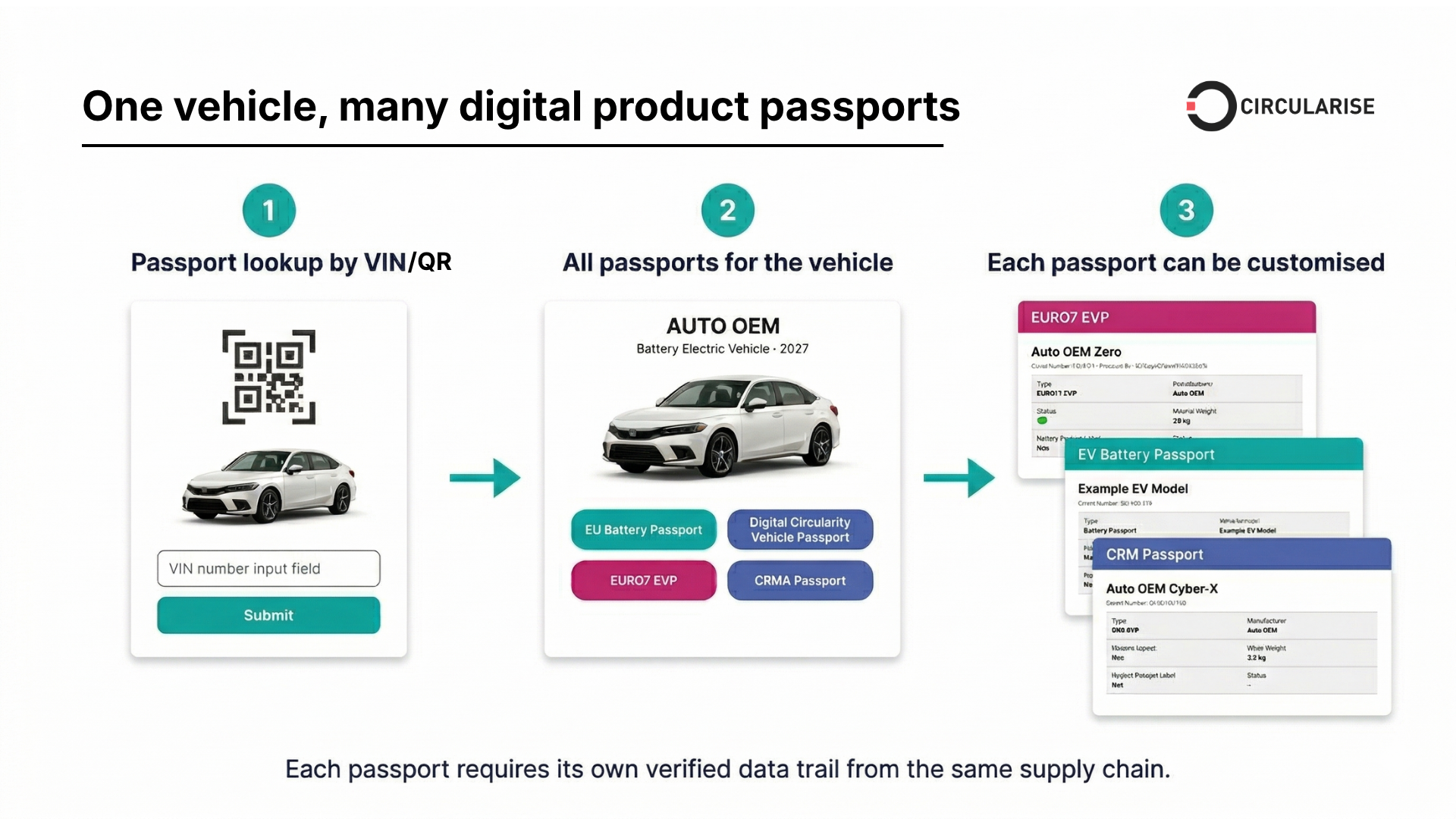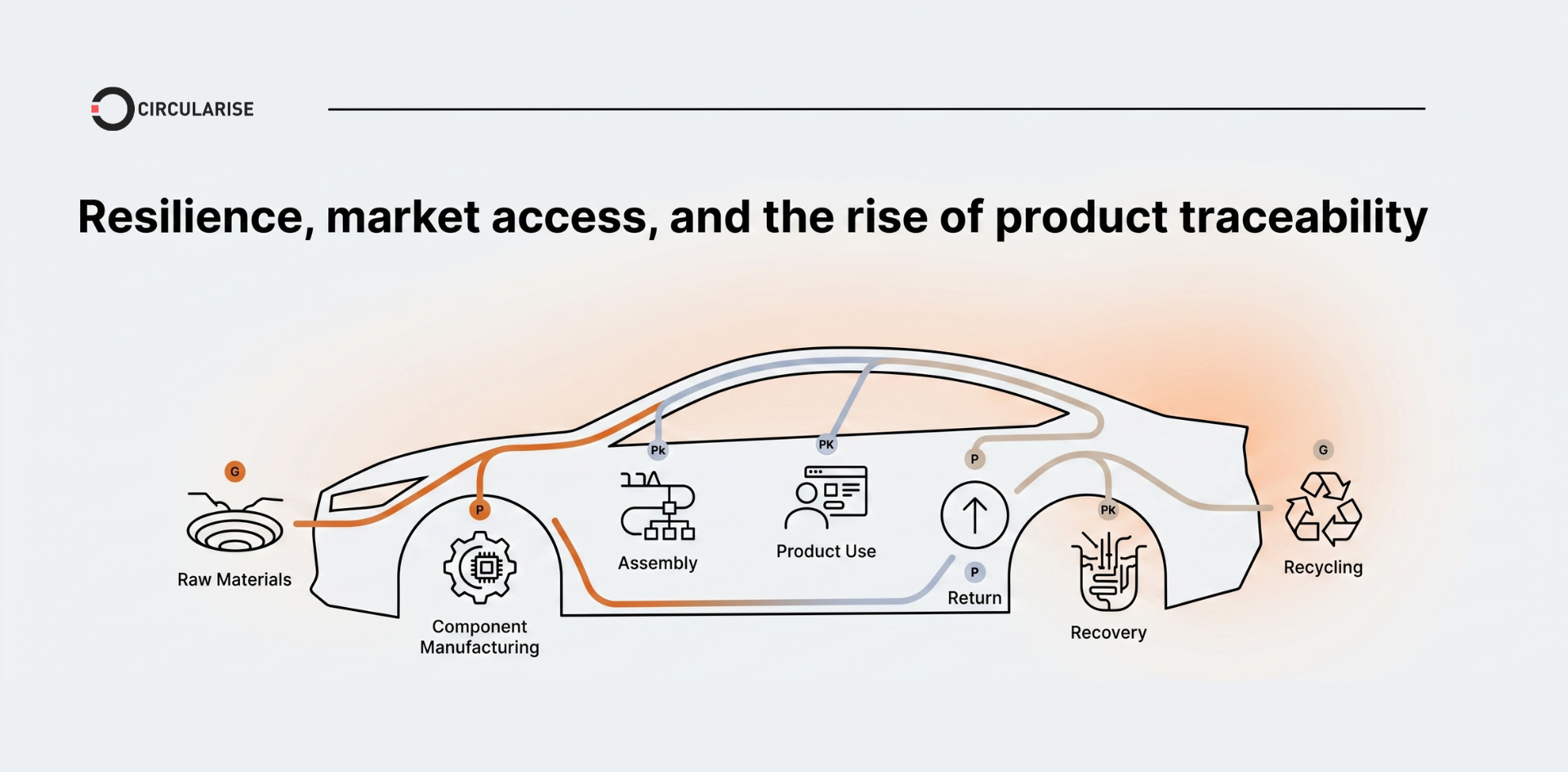
The conversation has changed across Europe’s manufacturing landscape - for everything from hot topics like batteries and electric motors to the more mundane home appliances. The EU’s green regulatory toolkit is no longer a distant possibility; the Ecodesign for Sustainable Products Regulation (ESPR), the Critical Raw Materials Act (CRMA), and the Battery Regulation are already binding frameworks that redefine what it means to make and sell a product in the EU. For many, this regulatory wave feels overwhelming, if not existential.
But this perspective misses the forest for the trees. These regulations are more than bureaucratic hurdles; they signal a fundamental shift in the global economy. They are the blueprint for a new, transparent, and resilient industrial era. The companies that will thrive are those that see beyond the checkboxes and red tape. They understand that the data required for compliance is the same data that can de-risk supply chains, attract investment, and create an unassailable competitive advantage.
All of these regulations and more require a rethink on how we manage sustainability data. The old way — sifting through scattered spreadsheets and taking a year to make one-off Life Cycle Assessments (LCAs) — is breaking under this new regulatory pressure. It’s slow, error-prone, and fails to provide the holistic, verifiable insight now demanded by both regulators and the market. A new way to see the whole picture, with less work, is needed.
This is the precise challenge that the strategic partnership between Circularise and Minviro, within the CSyARES project, was built to solve. By integrating full supply chain traceability with expert LCA into one seamless workflow, we are helping businesses turn regulatory pressure into a powerful engine for resilience and growth.
From fragmented data to integrated intelligence
Circularity today is often held back not by intent, but by fragmentation. Supply chain data lives scattered across the spreadsheets of multiple departments and companies. LCAs are conducted once a year due to the time and resources required to complete them. Information exchange depends on emails or PDF certificates, propped up by a tangle of bilateral NDA agreements. It’s a manual, error-prone process that makes transparency slow and costly.
Three pain points dominate this landscape:
- Disjointed traceability — Suppliers often hesitate to share data, fearing IP exposure or competitive risk.
- Incomparable LCAs — Without standardised methodologies, two assessments of the same material can yield wildly different results.
- The “primary data” bottleneck — Regulations now demand site-specific data, not global averages. Collecting this manually from tiered suppliers is nearly impossible.
Circularise and Minviro have joined forces to solve these challenges head-on — building a fully integrated system that connects traceability, data confidentiality, and sustainability assessment into one seamless digital workflow. Circularise’s blockchain system collects, connects, and collates verified supplier data into a Digital Product Passport ready for regulatory compliance. This feeds into Minviro’s dynamic LCA methodology, built on EU Environmental Footprint, which provides the quantitative basis for carbon footprint reporting. The resulting data is secure, traceable, and auditable, fulfilling battery passport regulatory requirements while building market trust.
The Circularise–Minviro partnership addresses a systemic gap in data connectivity by offering a ready-to-deploy architecture that operationalises the regulatory intent — connecting material traceability, LCA, and verification across supply chains.
From obligation to opportunity
The new generation of EU legislation reframes circularity from an optional virtue to a market condition. Each regulation aims to establish verifiable, data-based systems that align environmental ambition with industrial pragmatism. Combined, they unlock an immense business opportunity.
The Ecodesign for Sustainable Products Regulation (ESPR) embeds sustainability by design
The ESPR redefines what it means to bring a product to market in the EU. Adopted in 2024, it mandates that every product must be designed with durability, reparability, recyclability and energy efficiency in mind. Its purpose is to make sustainable products the norm by setting performance and information requirements throughout a product’s lifecycle.
ESPR regulatory Requirements include:
- A Digital Product Passport
- Substances of Concern
- Repairability & durability
- Efficiency (energy/water)
- LCA & carbon footprint
- Recycled content
- End-of-Life & disassembly
- Traceability of key components
The most transformative feature it introduces is the Digital Product Passport (DPP) — a digital record that links every product to its material, environmental, and compliance data across the value chain. This interoperable digital tool gives regulators, recyclers, and even consumers access to information to help them make their decisions on what to approve, buy, or recycle. Each product listed in the Regulation must have a digital identifier that contains verified data on its composition, origin, and environmental impact. This level of regulatory and consumer-facing transparency is unprecedented.
For industry, the ESPR transforms sustainability from a communication issue into an operational requirement. For specific product categories such as batteries, electronics, and textiles, it will become mandatory to have a DPP if they want to be sold on the EU market in the coming years. Companies must demonstrate how their products perform against measurable indicators — and this can only be achieved through reliable, standardised data systems.
With all of this measurement comes the opportunity of management. By building the data systems and Digital product Passports, companies can substantiate their green claims and build customer trust.
The Critical Raw Materials Act (CRMA): Securing supply through transparency
CRMA regulatory requirements include:
- CRM traceability
- Origin & processing data
- CRM footprint (LCA stage)
- Recycled CRM content
- Verified CRM data
- Due diligence
- Supply-risk analysis
- CRM flow monitoring
The CRMA establishes the EU’s strategy to ensure a resilient and sustainable supply of critical raw materials (CRMs) essential for clean technologies and digital infrastructure. It sets clear targets: by 2030, the EU must domestically achieve 10% extraction, 40% processing, and 25% recycling of its strategic raw materials. For manufacturers, this means every magnet, motor, or circuit board component containing rare earths must have traceable sourcing and environmental data.
In sectors such as electronics and home appliances the CRMA revolutionizes the procurement process, making access to data the most valuable aspect. Manufacturers must now know where their materials come from so they can demonstrate how sustainably it was produced and refined, justifying their procurement with due diligence on data availability. They also have to show the recyclability of the critical raw materials in their products. This necessitates a system that creates a transparent auditable record of how critical raw materials are sourced and processed, giving procurement departments the opportunity to reduce the risk of supply chain shocks.
The Battery Regulation: A template for product-level accountability
Battery Regulation requirements include:
- Battery Passport
- Carbon footprint
- Substances of Concern
- Recycled metals content
- Due diligence
- Battery performance
- State of Health & State of Charge
- Replaceability & Safety
- End-of-Life & Recycling
The Battery Regulation entered into force in 2023, setting the model for how ESPR and other product regulations like the CRMA will function in practice. All batteries sold in the EU must have a Digital Battery Passport by February 2027. Manufacturers will need to report the battery’s carbon footprint as well as minimum recycled content and sourcing details of specific materials such as nickel, cobalt, and lithium, using primary, site-specific data. All of this data needs to be regularly updated.
As the first implementation of the Digital Product Passport, this regulation has become the model for future compliance systems across all sectors. It establishes a unified EU data record for manufacturers to follow. The message begins with batteries and will expand to all complex products. Without traceable, primary data, compliance will not be possible.
A Convergence of Opportunities
The three pieces of legislation above, while distinct, share some key similarities in their approach to regulatory compliance:
- Data transparency and digitalisation are core principles for compliance
- Accountability extends across the product’s entire life cycle, from extraction to end-of-life.
- Primary data and standardisation replaces estimates with verified, comparable metrics.
Challenges towards meeting these approaches are often framed as burdensome and resource intensive, compliance is administratively burdensome and fragmented. However, this shared practical challenge means solutions can be shared as well. There are a number of common data points across these pieces of legislation, using interoperable digital infrastructure allows compliance with one regulatory act to contribute towards the others. Linking data management reduces the resources required to reach compliance; when regulations change, users can save resources when proving compliance by recombining existing data in the same system instead of starting over.
The legislation also provides a combined opportunity built into achieving compliance. The level of visibility needed for each legislative piece gives companies the power to make changes that benefit their business and their bottom line. Substantiating green claims builds trust and brand reputation among consumers and suppliers alike. Life cycle analysis with primary data identifies correctable inefficiency; more efficient physical resource use makes financial resources available for resilience and reinvestment. Visibility means control over supply chain risks, with easy opportunities to mitigate bottlenecks. At a higher level, this wealth of product data guides decisions about product redesign for sustainability.
In short; once things are measured, they can be managed to your benefit.
There is also a critical window of opportunity for early adopters. Compliance with the legislation upstream means customers don’t have to put resources into upstream data collection, those resources can go towards paying more for the products. Data brings additional value to the physical goods.
A synergistic solution for unified sustainability data
Circularise and Minviro developed a system for that opportunity in the CSyARES Project. The two platforms work together to connect verified supplier data through Circularise’s blockchain platform and quantify environmental impacts via Minviro’s LCA models. This directly responds to these needs by creating a transparent, auditable record of how critical materials are sourced and processed. It is designed as a single, cohesive system that replaces fragmentation with flow. By transforming raw data into auditable insight through a streamlined, four-stage process, it is a bridge between policy objectives with industrial realities.
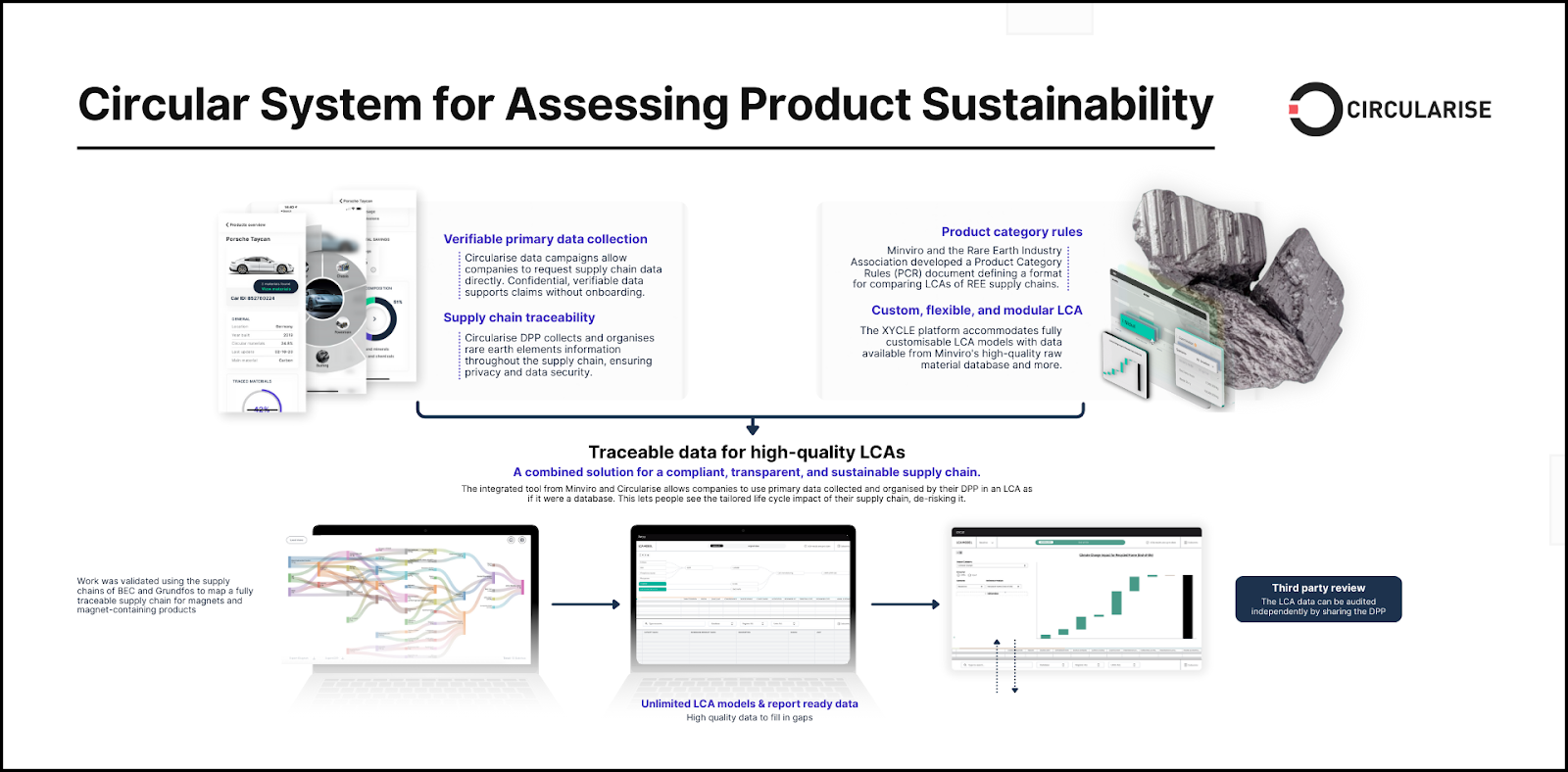
Stage 1: Foundational traceability with Circularise’s Digital Product Passport
It all starts with capturing the right data. Circularise’s DPP platform enables companies to trace materials and collect primary data securely from every actor in the value chain. Crucially, this is done with a pioneering focus on data confidentiality. Suppliers can share sensitive process information across the full supply chain without revealing intellectual property, breaking down the data-sharing barriers that have long plagued supply chain transparency. The owner of the data remains in control of that data, no matter where it is shared along the supply chain. Downstream actors can assess the impact of their supply chains without exposing the raw data at the heart of industrial trust and sensitivity issues. A key co-benefit is directly solving the problem of scattered spreadsheets by creating a single, secure source of truth.
Stage 2: Standardisation Through Product Category Rules (PCRs)
To solve the LCA comparability crisis, you need a common language. This is where the joint expertise of the Rare Earth Industry Association (REIA) and Minviro proved critical in the project. They co-developed a Product Category Rule (PCR) for the industry. A PCR is a standardised guideline that sets the rules for conducting an LCA for a specific product category. It dictates everything from system boundaries to which impact categories to measure.
By structuring the data collection in Circularise’s DPP according to the PCR, you ensure that every data point is gathered in a way that is ready for a standardised, comparable, and credible LCA. This is the bridge that connects traceability data to LCA science and method.
Stage 3: Dynamic, Primary Data-Driven LCA with Minviro
With the data collected and standardised in the DPP, it is seamlessly fed into Minviro’s LCA software platform, XYCLE. This is where the magic happens. Instead of relying on generic secondary data, XYCLE builds a dynamic LCA model using the primary data from your specific supply chain. The XYCLE platform lets you build a model from the unit process, allowing you to capture every step of the material’s journey along the supply chain. The seamless data fed from Circularise to XYCLE can be selected as a personal database of impact and emission factors, unique to your supply chain. For additional accuracy on complex internal processes Minviro also allows companies to build their own custom datasets and emission factors.
Combined, this allows you to move beyond theoretical impacts to understand the real environmental footprint of your products, covering a comprehensive set of impact categories from the EU’s Environmental Footprint 3.1 method, including climate change, water use, and resource scarcity. LCA is a powerful decision-making tool fueled by primary data.
Stage 4: The auditable, verifiable record
The final step closes the loop. The results of that LCA — the calculated carbon footprint, resource use, and other impacts — are fed back into the Digital Product Passport. This creates an immutable, verifiable record of the product’s impact, allowing companies to give their products a competitive edge in an increasingly sustainability-focused economy.
This means every claim in the DPP is backed by a robust LCA, and every data point in that LCA is traceable to a specific, auditable source in the supply chain. This is the gold standard for proving compliance and making credible sustainability claims.
Traceability in practice
Integration Walkthrough: A dishwasher built for circularity
To understand how this integration works in practice, imagine a European appliance manufacturer designing a dishwasher. It is made of a steel frame, plastic parts to direct water, some electrical components, and a water pump with an electric motor. Inside that motor, rare-earth magnets play a critical role in the pump’s performance. Under new EU rules, the company must demonstrate both responsible sourcing and quantified environmental impact for these components from the ESPR, and they need to make sure the water pump is compliant with the CRMA guidelines.
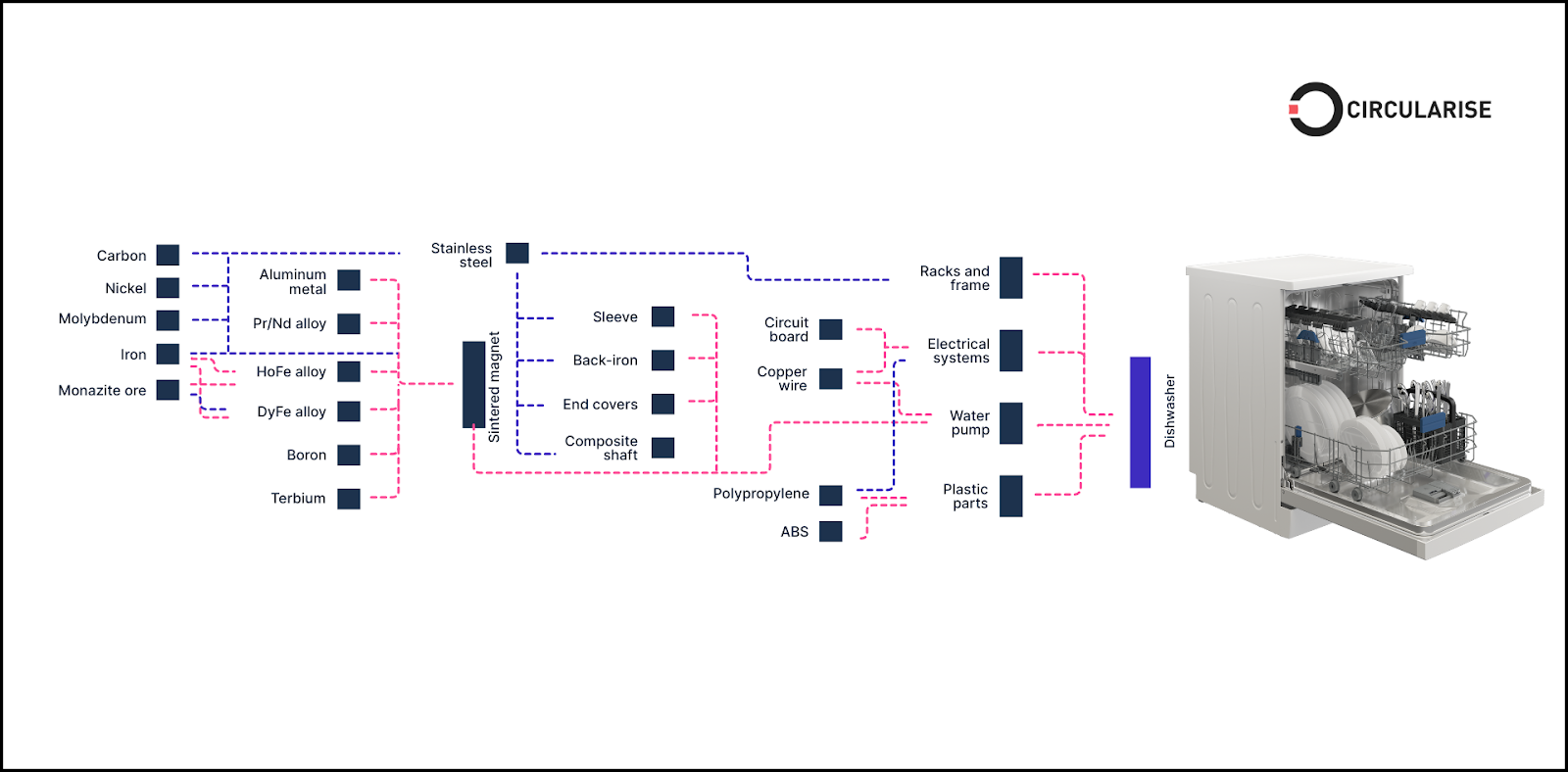
The manufacturer starts by assessing the policy frameworks, understanding what data they need to be compliant with each regulation. Circularise can help with this aspect, supporting this first step by defining which data must be provided by the manufacturer and which must be obtained from suppliers. Then, Circularise helps them align their internal operations, gathering the data from across their factories and organizing it into a single source of truth: the Digital Product Passport. Using Circularise’s data collection tool, data requests are forwarded to suppliers, who can further forward it to their own suppliers if required, building up a complete picture of the supply chain. The manufacturer begins to see what materials their third-party components are made of, in what quantities, and their origins.
In parallel, the manufacturer’s sustainability team can begin to create a life cycle model for their dishwasher using Minviro’s XYCLE system. By defining the different unit processes and how they work together, Minviro’s system helps them to create a highly accurate model of their internal operations including starting materials, power emissions, assembly processes and waste streams. As the DPP becomes more complete and complex, the manufacturer can flexibly adjust their model in XYCLE to match the specific suppliers, materials, and processes for their product.
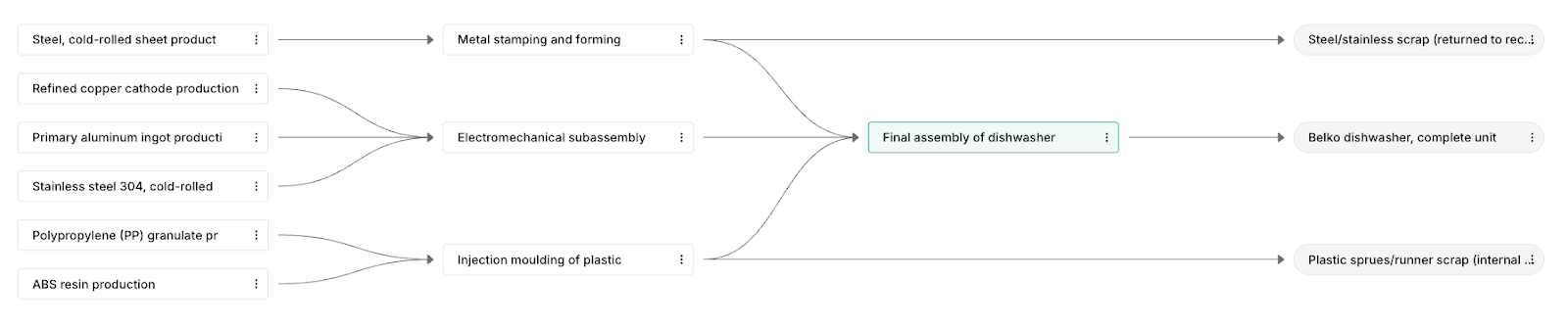
When ready to run the model, the manufacturer connects its Circularise and Minviro accounts, allowing them to use their product’s Circularise DPP as a database for emission factors in Minviro’s software. The product category rules for the rare earth elements in the dishwasher’s water pump further streamline this process. Where data might be missing from the DPP and the primary supply chain, XYCLE lets the manufacturer pull from other databases to fill in critical gaps.
Having assigned all of the emission factors using primary data from Circularise’s DPP, any remaining gaps can be filled using other databases connected to the XYCLE software. Running the analysis results in a bespoke, individualised LCA report for the dishwasher, unique to the manufacturer. Data from the supply chain is directly reflected in the final life cycle impact report. The report gets written back into the DPP and serves as an immutable record of the dishwasher’s sustainable life cycle. Elements of the LCA report like the carbon footprint are combined with data from the supply chain to demonstrate compliance with the ESPR and the CRMA at the same time, in one document. The manufacturer has accomplished multiple years worth of work in a much shorter timeframe, to a higher standard than their competitors,
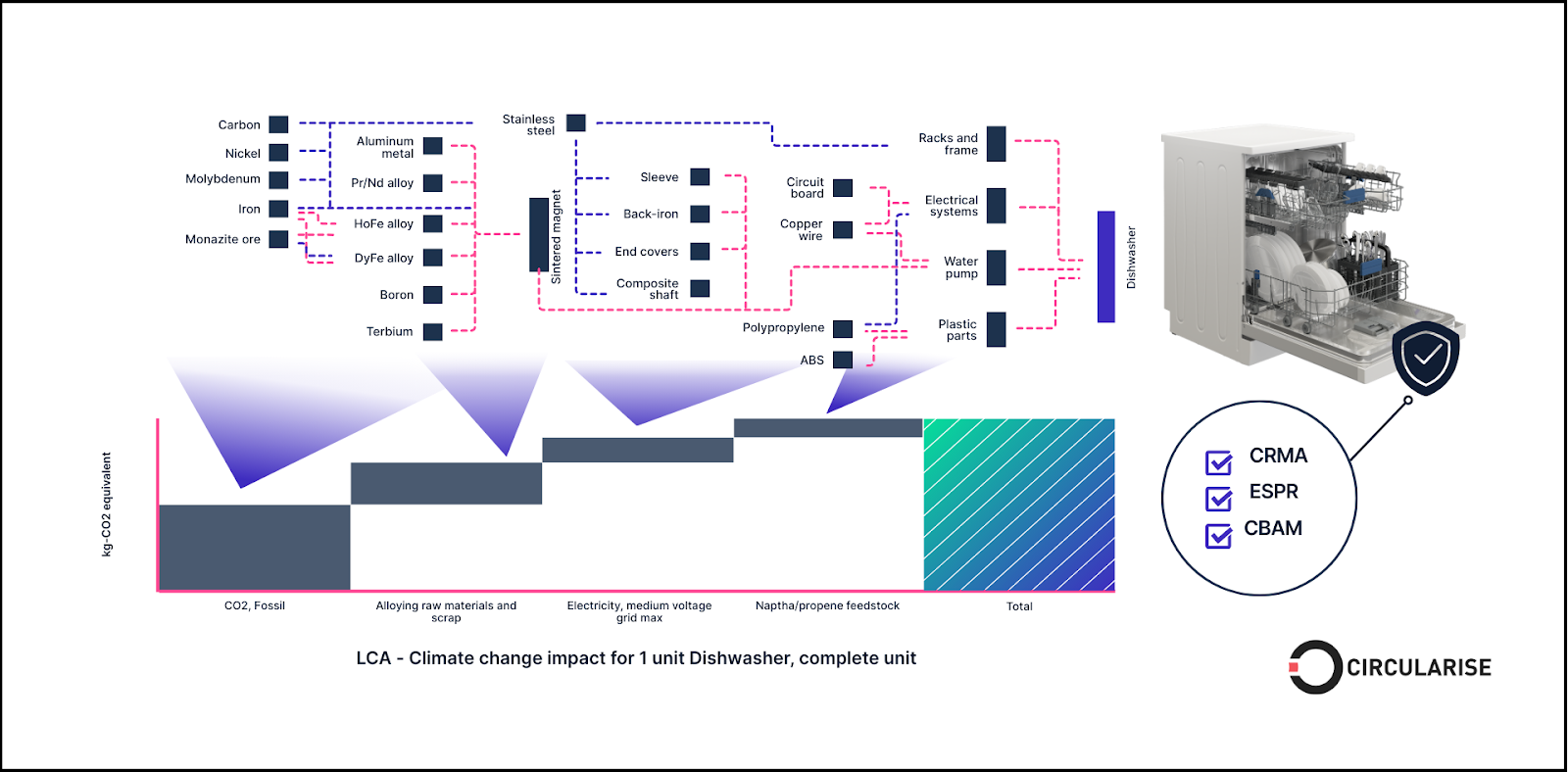
Armed with granular supply chain and sustainability information, the manufacturer can now take advantage of the business opportunities provided by Circularise and Minviro’s integrated data solution. The procurement team uses Circularise’s platform to identify and mitigate critical risks in the supply chain, making the company more resilient and competitive. For example, the operations team identifies higher than expected electricity use in some assembly processes. Correcting these mistakes reduces the utility bill at the factory. Meanwhile, the design team checks the LCA results using primary data and identifies hotspots on the XYCLE platform. They identify strategies to reduce the size of the pump, reducing the amount of critical raw materials required in the final product. That eases their reporting burden and saves on the cost of manufacturing. All of this information is fed to the marketing team, which can share the results of the LCA and improvements to it using Circularise’s verifiable DPP, grounding their claims in traceability and building trust among their customers.
From compliance cost to strategic asset
As the study above demonstrates, by implementing this integrated system, compliance becomes a natural output, not the sole objective. The real value is unlocked in the strategic business advantages it delivers.
1. Future-proof and streamlined compliance
The integrated system is designed for today's and tomorrow's regulatory landscape. Whether it’s generating a DPP for the ESPR, providing recycled content for the CRMA and Battery Regulation, or providing due diligence data for the CSDDD, the required data is already available, verified, and formatted correctly. This drastically reduces the time, cost, and stress associated with responding to new regulatory demands.
2. Unrivalled supply chain resilience and de-risking
With a transparent supply chain and a precise LCA, you can move from reactive firefighting to a proactive strategy. You can identify environmental and geopolitical hotspots before they disrupt your operations. This allows you to diversify suppliers, negotiate from a position of knowledge, and make strategic investments in the most impactful areas of your supply chain. This is the very definition of de-risking.
3. Credibility that attracts investment and wins customers
In a market saturated with green claims, verifiability is currency. A DPP backed by a primary-data LCA transforms your sustainability story from marketing rhetoric into an auditable fact. This is incredibly powerful for ESG reporting, satisfying investor demands, and winning contracts in green procurement tenders where proven sustainability is a key differentiator.
4. Informed R&D and sustainable product design
The ultimate value is achieved when this data is leveraged at the very beginning of the product lifecycle. Engineers and designers can use the LCA insights from ‘Cycle’ to understand the consequences of their material and process choices in real-time. This enables true eco-design, creating products that are not only compliant but also inherently more sustainable and cost-effective to produce. As Jordan Lindsay notes, this approach future-proofs your products and provides "a benefit to the longevity of your sustainable solutions."
Conclusion: Building the sustainable enterprise of tomorrow, today
Europe’s regulatory landscape is redefining how business and sustainability intersect. Far from being a limitation, this legislative wave is a strategic framework for competitiveness, driving companies to build cleaner, smarter, and more resilient operations grounded in verifiable data.
The partnership between Circularise and Minviro embodies this shift. By uniting traceability and life-cycle assessment in a single, interoperable system, it delivers the data infrastructure needed to translate policy objectives into measurable industrial outcomes while reducing administrative burdens.
Crucially, this approach is not limited to one industry or material stream. The same model can be applied across sectors — from electronics and home appliances to construction, automotive, textiles, and consumer goods. It represents a scalable foundation for innovation, supporting the vision of digital and circular markets.
It is more than a technological evolution. Companies will not only comply with regulation but define the next generation of industrial leadership — one based on trust, traceability, and circular design. Regulation is no longer a checklist, but a blueprint for innovation.
Contact us today to schedule a personalised demo and see how the Circularise and Minviro integration can transform your supply chain transparency and sustainability reporting.

Circularise is the leading software platform that provides end-to-end traceability for complex industrial supply chains. We offer two traceability solutions: MassBalancer to automate mass balance bookkeeping and Digital Product Passports for end-to-end batch traceability.
Talk to the Circularise team to assess your primary data readiness and design a traceability for your supply chain.