
Building a transparent solar future: How Circularise and FAIR PV pioneered circularity with Digital Product Passports
The FAIR PV project confronted a critical industry paradox: the rapid growth of solar energy, essential for decarbonisation, was creating a future waste crisis and opaque supply chains. Traditional solar panels are notoriously difficult to recycle and offer no visibility into their material provenance or lifecycle performance.
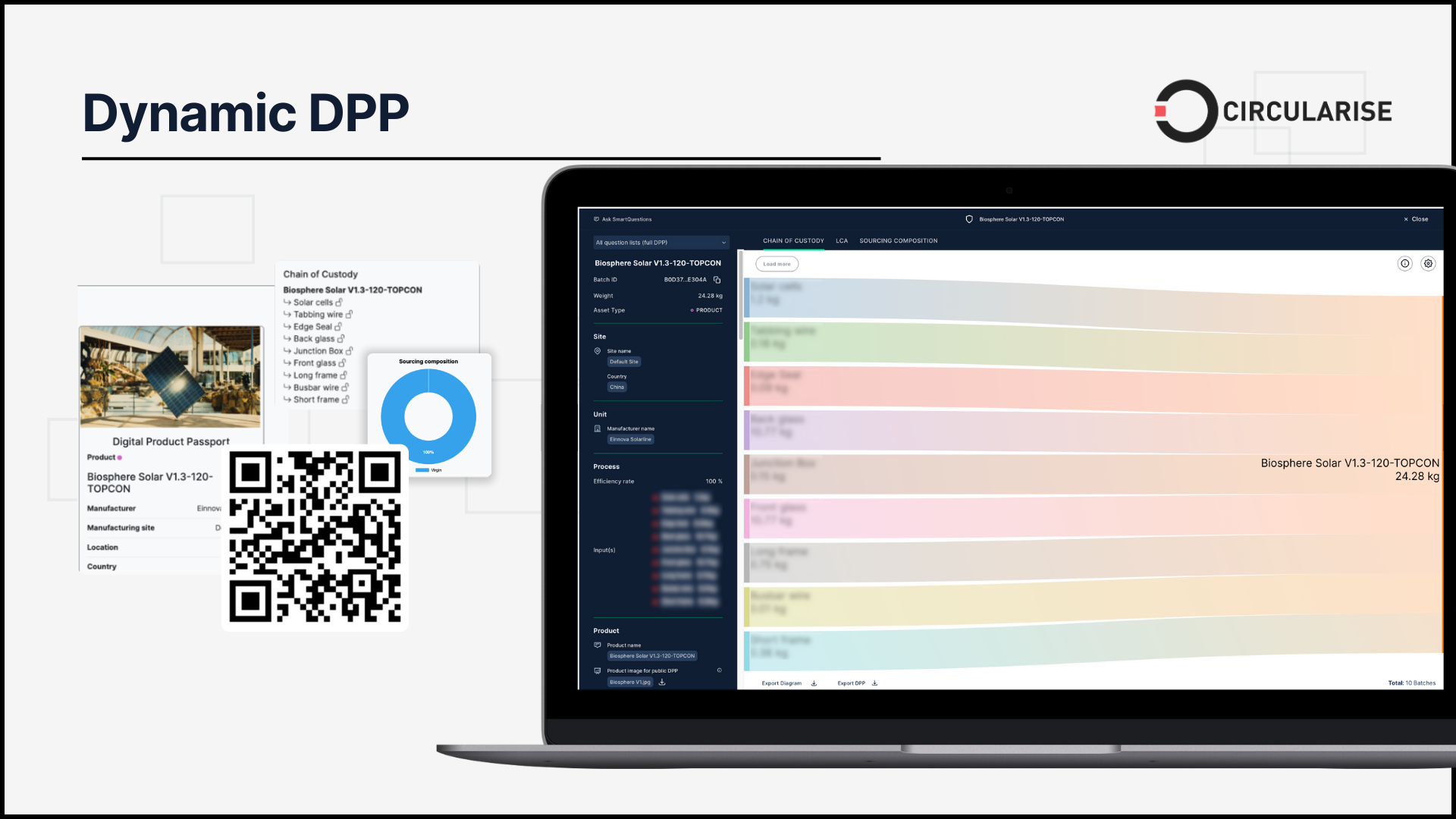
Partnering with Circularise, the consortium developed a dynamic Digital Product Passport (DPP) for a novel, repairable solar panel. This provided a secure, verifiable record of materials, manufacturing, and performance data across the entire value chain. The project proved that radical transparency is not only possible but is the key to enabling circular strategies like refurbishment, high-value recycling, and compliance with stringent new regulations.
.png)
The energy transition must be built on a foundation of transparency and circularity. Our collaboration with Circularise is central to this mission. Their technology allows us to prove the sustainability of our panels—from ethical raw materials to end-of-life recyclability—without compromising sensitive IP. This isn't just about compliance; it's about creating a new, fair standard for the entire solar industry.

Successfully defined a comprehensive data ontology and launched a functional DPP prototype for solar PV.
Established a framework for secure, confidential data sharing among competitors and supply chain partners.
Created the foundational transparency required for compliance with the EU Ecodesign for Sustainable Products Regulation (ESPR) and CSRD.
About the Fair PV Project
The FAIR PV project is a Dutch consortium comprising Biosphere Solar, AMS Institute, and TU Delft, funded under the Knowledge and Innovation Agenda for Circular Economy (KIA-CE). Its mission is to develop the world's first fully repairable, refurbishable, and transparently sourced solar PV module. The project combines hardware innovation (liquid-based encapsulation, modular design) with digital innovation (dynamic DPPs) to advance the solar industry towards a circular future.
About

Circularise is a supply chain traceability software provider based in the Netherlands. Its patented Smart Questioning technology enables companies to share verified information across complex supply chains without revealing confidential data. Circularise’s platform provides the foundation for Digital Product Passports, simplifying compliance with regulations like the ESPR, Battery Regulation, and CSRD. Trusted by industry leaders like Asahi Kasei, DOMO Chemicals, and Mitsubishi Chemical, Circularise turns traceability into a strategic advantage.
Why FAIR PV chose Circularise
The FAIR PV project began with a clear goal: to move solar panels from disposable products to durable, circular assets. Biosphere Solar’s hardware innovation, a panel designed for disassembly, solved only part of the challenge. The consortium still needed a digital layer to prove circularity claims and enable new business models.
Their selection criteria were stringent. The solution needed to:
- Provide end-to-end traceability from raw materials to end-of-life, far beyond tier-1.
- Ensure confidential information sharing to protect the IP of all supply chain participants (e.g., material formulas, processing techniques).
- Be interoperable and capable of handling dynamic, real-time data like performance degradation and maintenance history.
- Deliver audit-ready documentation for regulators and certifiers.
- Provide a direct path to compliance with the EU Ecodesign for Sustainable Products Regulation (ESPR).
Circularise was the only platform that met all these criteria, offering a secure, scalable, and supplier-centric approach to transparency.
Proof of concept and implementation
The PoC focused on developing a dynamic Digital Product Passport (DPP) tailored to the solar industry's unique needs. The work was structured in two key phases:
- Ontology development (TU Delft & Circularise)
The team developed a sophisticated data ontology — the blueprint for the DPP. This involved mapping 176 data classes and 131 properties to capture everything from raw material origin and toxic substance content to real-time energy output and repair history. Insights from 12 stakeholder interviews revealed a critical industry need: data on a panel's current condition is more valuable for reuse/refurbishment decisions than its original specifications. - Platform integration & prototyping (Circularise)
Using this ontology, Circularise configured its platform to create a working DPP prototype. The platform employed its patented Smart Questioning technology, allowing different actors in the chain (e.g., glass supplier, cell manufacturer, recycler) to respond to verified data requests without exposing their entire dataset. The prototype showcased key information for compliance and circularity, including recycled content, carbon footprint, material composition, and a verifiable chain of custody.
Key outcomes
The collaboration delivered tangible, strategic outcomes that prepare the FAIR PV consortium for a circular future:
- Supply chain transparency achieved: Mapped the entire solar PV value chain within a standardised ontology, creating a single source of truth for all product-related data.
- Digital Product Passports deployed: Launched a functional, sector-specific DPP prototype that aggregates static (e.g., bill of materials) and dynamic data (e.g., predicted health) into a secure, accessible record.
- Confidential information sharing proven: Demonstrated that competitors and partners can collaborate and share necessary sustainability data using Smart Questioning, all while preserving business-critical IP.
- Regulatory preparedness secured: Built a system that is pre-aligned with the data requirements of the EU's ESPR, CSRD, and potential future solar-specific mandates, de-risking the compliance journey.
- Audit-ready documentation: Established an immutable, blockchain-backed record of material provenance and chain of custody, providing undeniable proof for sustainability claims and certifications.
Expansion and future plans: Scaling circularity
The successful PoC is not an endpoint but a launchpad. The FAIR PV consortium is actively planning the next phases:
- Living lab validation: The DPP and circular panels will be tested in a real-world environment at the Innovation Pavilion in Amsterdam, involving installers, maintainers, and recyclers to validate the workflow and business case.
- Commercialisation of circular panels: Biosphere Solar will utilise the DPP as a core component of its market differentiation and sales strategy, targeting sustainability-driven public and private organisations.
- Industry-wide adoption: Circularise is leveraging the FAIR PV ontology and learnings to onboard other solar manufacturers and recyclers, promoting an industry-standard approach to traceability that unlocks circular economies of scale.
Closing Statement
The FAIR PV project demonstrates that traceability is the critical enabler that bridges physical circular design and circular business models. The collaboration between Circularise and the FAIR PV consortium proves that companies can meet ambitious sustainability goals, comply with evolving regulations, and build supply chain resilience—without sacrificing competitiveness or intellectual property.
This project moves us from theory to practice. We're not just building a better solar panel; we're building the trustworthy data infrastructure that makes the entire circular economy possible. Circularise provides the missing link between our innovative design and the market's need for verified, actionable truth.